Jim Bentley’s memoirs Part 4 World War 2

 The outbreak of war caused quite an upheaval on the farm. On 1st September  1939  John and Ernest were called up into the regular army as they were both in the Territorial Army as were many lads in the village. They were greatly missed on the farm so it was all hands on deck for the duration of the war and we all had to help. German and Italian prisoners of war came to work on the farm as did the Borstal Boys from Lowdham. Dad always gave them five Woodbine cigarettes per day as well as eats and drink.

 The first night of war, on Sunday 3rd September 1939, the sirens sounded all over the country. Looking back that first night was funny really as no one seemed to know what to do. We had all been issued with gas masks and identity cards and some people put their gas masks on, some stayed in bed, a lot of people got up and sat under the table. We all thought the end had come and we wouldn’t survive the first night of war but eventually the all clear sounded and with a sigh of relief we went back to bed; later we found out that the alarm had been triggered by a single unidentified aircraft crossing the channel.

 The blackout began at the outbreak of war and lasted for six years – not a chink of light was allowed. The Air Raid Wardens ( dad was a warden) saw to that; you could be fined for showing any light and most people had blackout curtains, blinds or shutters fitted.  At Fiskerton some girls arriving home late left a light showing and a German bomber unloaded his bombs on the village destroying several houses but luckily with no loss of life.

In 1940, after the fall of France, the British stood alone and farmers were encouraged to plough up all the grass fields and meadows to grow more food. As most of the fields were undulating with humps and hollows they had to be levelled out and to do this Fowlers of Leeds designed a large Gyrotiller; it was a vicious looking monster on tracks like a tank with large contra-rotating tines which not only levelled the ground but took out hedges in one fell swoop and uprooted large trees. It ran on diesel and was certainly a mean machine the like of which we hadn’t seen before. Poles were placed over all the fields to prevent German aircraft and gliders landing in an invasion but they also prevented our own aircraft from landing in an emergency. The Air Ministry paid dad the princely sum of 1s per pole per year for the inconvenience of these poles

The majority of food was rationed during the war as were clothes.  ration books were needed for all fats, butter, margarine, bacon, cereals, milk, cheese, sugar, bread, meat and chocolate. Many foods were not available at all; these included imported fruit and vegetables, tinned fruit and jellies. The lack of oranges, raisins and sultanas meant that Christmas became a rather austere occasion and prunes were used in the Christmas cake in lieu of mixed fruit. For ten years we never tasted a banana, peach, apricot or pineapple and the only fruit we had were those from our own orchard and garden.

Ration book from World War 2

WW2 ration book0002

The wireless was the main source of information; the news was a must as were the speeches of Winston Churchill. Some nights we would tune into William Joyce , Lord Haw Haw, broadcasting from Germany with all his propaganda news; he was hanged after the war as a traitor. The most popular programme was ITMA with Tommy Handley and characters such as Colonel Chinstrap and Mrs Mopp; 90% of the population must have tuned in on a Thursday night. Often the BBC news would report ‘German bombers last night dropped bombs at random’ and old chap in the village, Matt Holmes, used to say ‘ I’m glad I don’t live there – they get bombed most nights’.

One evening a barrage balloon, which had broken from its moorings at Derby, drifted across to Thurgarton and settled in an oak tree in Station Road. Torn and partially deflated it looked in the moonlight like a large parachute. People thought the German invasion had started and called out the Home Guard.

Local Home Guard

home guard

There were two anti-aircraft /searchlight batteries stationed at Thurgarton , one at Bankwood  and one in Station Road. The soldiers were always invited for tea and also for baths. We used to visit the searchlight camps and take them newspapers, magazines, Picture Post, Tit Bits for them to read ; we would peel potatoes for them and generally be a nuisance but they didn’t seem to mind.

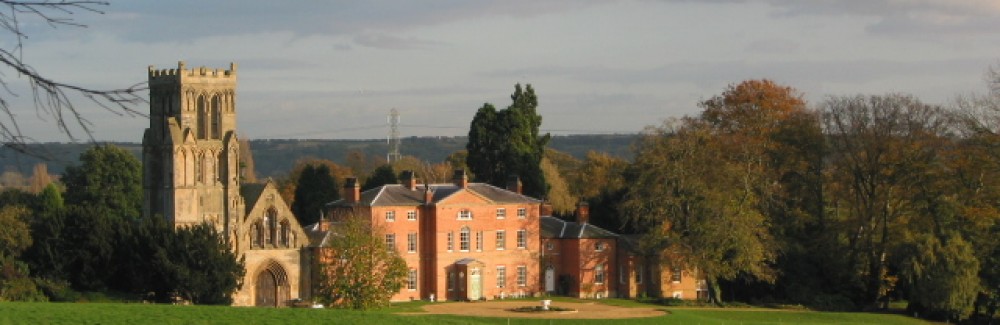
Thurgarton Priory became a Military Convalescent Home and servicemen from there wandered about the village in their hospital blue suits, red ties and white shirts. One of them used to come to the farm and spend all day watching the pigs – he said he got more sense out of them than from the servicemen at the Priory.

We had many evacuees at Thurgarton from Sheffield, Southend and Worthing. We had three at the farm from Southend – Jim Corder aged 3 ( who later became an Air Steward), Peter Povey aged 9 and Gordon Blanchflower aged 14. Walter and Lucy Rogers next door had a little boy from Sheffield and on his first night we asked him what he usually had for supper and he replied ‘ beer and chips’; needless to say he didn’t get  that.

The war in the air

School in war time included gas mask drills, time in air raid shelters, watching troop convoys and the odd German bomber being shot at by Ack-Ack guns.The most we saw of the war was in the air.

Early on many Fairy Battles, Wellingtons and Hampden bombers flew overhead on their way to Germany . On most nights in summer 1940 about 30 Armstrong Whitworth Whitely bombers would go chugging over with their noses in a downwards attitude flying from their bases in Yorkshire to targets in North Italy; the next morning you could see the survivors chugging back again. 

At the height of the bombing campaign in 1943 over 500 bombers would fly over Thurgarton on their way to Germany –Halifaxs, Lancasters and Stirling; you could count 50 bombers in the air at any one time. Every evening the peace of the village was shattered for half an hour by the roar of over 100 Merlin engines as 30 Lancasters took off from Syerston, one after another roared low over the village; we would stand in the farmyard and count them.

Lancaster bomber

LancasterBomber

Later in the war when the Americans joined in, large formations of B17 Flying Fortresses and Liberators flew everyday on their daylight raids on Germany. They flew at 30,000 ft with large vapour trails streaming after the formations. A sight never to be forgotten was just before D-day when large formations of Dakota transport towed Horsa, Waco and Hadrian gliders , some towing two at a time. Part of the training was to fly low at tree top height over the villages and fields at night – they were lit up with green orange and yellow lights making an unforgettable sight.  

Air crashes

Some of them didn’t make it and we had about 15 air crashes in the area :- at Bleasby one Wellington and two Lancasters, at Thurgarton one Wellington and two Lancasters, Hoveringham two Lancasters, Southwell one Spitfire, Fiskerton two Lancasters. Gonalston one Lancaster and several bombers crashed near Syerston airfield. In total over 100 airmen were killed and only two survived.

Memorial to Lancaster crew at GonalstonOLYMPUS DIGITAL CAMERA

Every time an aircraft crashed we would jump on our bikes rushing off to see what we could do – which was nothing for we would always be met by some gruesome gory sight. One night a Lancaster crashed into the Trent at Fiskerton and another at Hoveringham on the river bank. Two Lancasters crashed within a fortnight of each other in almost exactly the same spot which was our field called Bottom Meadows; a year later you could still pick up bits of debris.

On another night two Lancasters collided over Bleasby. One was night flying from Metheringham and the other had just returned from Germany and about to land at Syerston. They were flying without lights and the wreckage was scattered over 40 acres of corn fields between Rudsey Farm and Brickyard Farm -16 aircrew died.

On the receiving end

On the receiving end several bombs were dropped by the Germans at Thurgarton , Bleasby and Fiskerton, a land mine at Thurgarton and one at Kneeton not to mention several incendiary bombs. Eakring , where there were oil wells, had many bombs one night. There was a decoy airfield at Magadales Farm which attracted the German bomber;  that’s where the land mine and some bombs fell as they thought it was Syerston.

I shall always remember one night at five minutes to six I was just taking my boots off when a huge explosion shook the house. We learned later that an incendiary had fallen on a loaded Lancaster detonating the 2,000 lb. bomb. The C.O. at Syerston , Group Captain Gus Walker, happened to be close and his arm blew off; I met him later when I was in the RAF.

There was only one Blitz on Nottingham and that partially failed. After the Germans had ringed Nottingham with marker flares two RAF planes from Hucknall laid decoy flares over the Vale of Belvoir and so the main Luftwaffe force dropped a lot of their bombs in the fields. Some did get through to Nottingham hitting Trent Bridge , the Station, Woolworths and the Co-op. An elderly couple, Mr and Mrs Suter, had moved from Thurgarton to the city and were killed in that raid. He had been the choirmaster at the church and lived at Southacre – they were buried at Thurgarton.  

One Friday afternoon some German bombers flew low level over Lincolnshire to bomb the Ransome and Marles ball bearing works at Newark. They hit the factory killing over 80 people and machine gunned the streets. Mary was at school in Newark and had to shelter in shop doorways. The planes came and went before there was time to sound the sirens or man the anti-aircraft guns.

In Derby one Monday morning at a quarter to eight a lone German bomber attacked the Rolls Royce works in Nightingale Road and machine gunned the streets. One bomb fell on the main stores and 11 workers were killed. The Luftwaffe pilot was shot down a fortnight later; he knew Derby very well having worked at Rolls Royce before the war.

The family at war.

Ernest joined the 8th Battalion Sherwood Foresters Territorial Army early in 1939 as did many of the village lads. They were promised a fortnights training in August 1939 at Holyhead in North Wales; most of them had never been far from the village so they thought they were onto a good thing. When they had finished training the Sergeant-Major said that he would see them all again in two weeks because there was going to be a war. They were all called up on 1st September into the Regular Army.

Ernest served in Norway, Northern Ireland, North Africa from El Alamein to Tripoli then Italy and the Anzio landings. I remember the day Ernest arrived back from the Norwegian campaign in April1940; it was a Sunday morning and he sat at the kitchen table from 7 to 9 o’clock telling us all about it. Many men had been taken prisoner by the Germans and the lucky ones who had got out in time had reached Andalnes where they were evacuated by the Royal Navy. At Anzio they were held on a narrow strip of land being shelled and bombed from the sea, from land and from the air for three weeks – he didn’t expect to make it back.

When Ernest and John came home on leave we would Blanco their army equipment and polish the brasses. Sometimes John would bring his Thompson submachine gun home or a Sten gun or rifle. The reward for cleaning it with spit and polish was to go into the orchard and fire off a few rounds into the air.

John joined the Sherwood Foresters but was transferred to the Royal Armoured Corps just before his old battalion was wiped out at Tobruk (9th  Battalion). He joined the Royal Dragoon Guards and saw action in Belgium , Holland and was one of the first over the Rhine into Germany. They met up with the Russians at Lubeck but they weren’t very friendly. They then moved north and were some of the first Allied troops into Denmark where they stayed for 6 months.

 Hilda spent most of the war as a Sergeant WAAF at RAF Cranwell where she met her future husband Howard who was a wireless operator. He had served on Lysanders in France and had been evacuated at Dunkirk. He transferred to 517 squadron flying Halifaxes  out of Braudy, South Wales. On D-day his plane developed engine trouble and ditched in the Atlantic 300 miles off Portugal. The eight man crew got into the two dinghies and on sighting a Catalina Flying Boat they fired off some distress flares one of which sadly dropped into one of the dinghies and sank it – so all eight men now clung to one dinghy. After three more days they were sighted by an American destroyer who transferred them to an Aircraft Carrier out hunting German submarines. They were eventually dropped off in Bermuda and flown home via USA and Canada. They were given a new aircraft but on their first operation from Braudy on returning from an eight hour patrol over the Bay of Biscay on a foggy November nigh they crashed into a hillside whilst circling to land. They were lucky to survive.

Phil remained on the farm and joined the Home Guard; Rene also remained at home to work on the farm and  Mary went to work in a bank in Nottingham but later on went to work in a garage.  I joined the Air Training Corps and used to visit the RAF stations at Newton and Syerston and the American 9th Air force  bases at Bottesford and Langar; a few flights in Wellingtons, Lancasters or Dakotas made it all worthwhile. The Americans always gave us a good time with ice cream and tinned fruit and rides in their jeeps around the base. On leaving school I joined Rolls Royce as an engineering apprentice and worked on the first jet engines; later in 1946 I joined the RAF.

After the war Ernest and John returned to work on the farm with Phil. Hilda married Howard and moved to Burton Joyce and Mary moved to Daventry after marrying Philip Benton. At least everyone came through the war safely but life was never the same again – that pre-war life had gone forever and all was about to change. One thing that stands out from the war was the friendliness and comradeship of all the people – we were all in it together.

John , Philip and Ernest Bentley on Manor farm

bentley brothers

Jim Bentley’s memoirs Part 3 Village life

Weekly routine

Groceries were delivered fortnightly to the village; a man came round on a Tuesday to take your order and it was delivered ten days later on a Friday. If you had forgotten anything it was just too bad, you had to wait another fortnight or hope the village shop had it. The Baker’s van was horse drawn as was the Greengrocer’s dray pulled by a horse called Bob. Meat was delivered to all the houses twice a week and a fishmonger came once a week on a motorbike and sidecar.

We had to cycle to Lowdham or Southwell for a haircut; it cost 3d by hand clippers and 4d when electric clippers came in. We would also cycle to Lowdham to collect a recharged accumulator for the wireless. We used to get dog meat from Hoveringham; it was horse meat painted with a green dye to stop you using it to eke out the meat ration.

Special days

Sunday was always treated as Sunday with no work on the farm apart from the essential work like milking cows and feeding the animals. We all wore our Sunday best clothes and went to church on Sunday morning, Sunday school in the afternoon and evening service later. In the summertime families went for a long walk after church on Sunday evenings. In winter Sunday meant a fire in the front room, the piano was played, stories told and games played.

On Armistice Day every year the whole country came to a standstill for the two minute silence to remember the dead of the First World War. Everything stopped and everyone observed the silence, the majority gathering around the war memorials in every town and village. Before the war school holidays included Oak Apple Day on May 29th to celebrate King Charles hiding in an oak tree, Trafalgar Day on October 21st –the Battle of Trafalgar, Pancake Day and Empire Day.

The Silver Jubilee of George V in 1935 was celebrated in style with the villages dressing up with flags and bunting and holding sports and street parties; we even named one of our horses ‘ Jubilee’. Granddad Robert bought all the children in the village a Jubilee Mug; it was the last generous offer of his life as he died later that year. Two years later in 1937 the celebrations were all repeated at the coronation of George VI.

Coronation day 1937 Thurgarton

coronation 1937

Games and hobbies

In pre-war days we played the usual football with jackets for goal posts, cricket with a rubber ball and stumps chalked on a wall and rounders. We also played tracking, fox and hounds, bowling a hoop (an old bike wheel without spokes), marbles, whip and top, cap guns, wheel barrows made from old pram wheels, conkers, roller skating, scootering, and cycling as far a field as Newark, Nottingham and on one day Doncaster. The games seemed to go in seasons. In spring it was skipping for the girls, marbles and whip and top for boys. In winter there was sliding on frozen ponds, sledging on Booker’s field, roller skating and tracking. In summer it was cricket and rounders and cycling and in autumn of course it was conkers and fox and hounds –a great time was had by all.

Collecting cigarette cards was a good hobby and every subject you could think of was represented : fish, flowers, trains, footballers, cricketers, animals, film stars, flags, ships and aeroplanes, to name a few. We used to go to a building site in Thurgarton on Sundays when the builders were off and collect almost a full set of cards from all the empty cigarette packets – a few swaps completed the set.

Train spotting , taking steam locomotive names and numbers, was a popular pastime. Newark was the place to go, to the LNER (London and North Eastern Railway) to see such famous engines as; The Flying Scotsman, The Mallard, Silver Link, Silver Fox, Sir Nigel Gresley and Silver Jubilee. Not many ‘Names’ passed through Thurgarton on the Derby to Lincoln line but quite a few could be seen at Nottingham Midland Station( London, Midland and Scottish Railway), especially the ‘City Class’ locomotives. Some Sundays ‘Uncle’ Harry , a train driver on the LNER, would take us to Colwick marshalling yards and give us rides on the steam loco around the yards. The engines were always coaled up and serviced on Sundays with grease gun, oil can and oily rag.

School holidays

School holidays were not all work on the farm. Fishing in the Beck we would catch eels, Bully Heads, Sticklebacks, Red Breasts, Silver Breasts, and minnows. Collecting tadpoles or newts from the various ponds around the village was also popular. We would go to see Mr Foster , the cobbler, to listen to his stories from the Great War or go to the blacksmiths shop to see Jack Milner and pump the bellows for the furnace to heat the horseshoes. One day one of our horses, Blossom, went to be shod and while Jack Milner had gone across the road to his house the horse walked home on her own and was found standing on the bridge with her head over the farm gate waiting for someone to open it.

Sometimes we visited Ernie Paling the joiner and wheelwright and watched him make coffins or repair wagon wheels. The railway station was another port of call to watch the steam pick-up which came every morning at eleven o’clock to collect or drop off trucks. The porter and signalmen always needed assistance to pull the levers for the points and signals. Mrs Statham at the village shop was another popular place where we could spend our pocket money – we could buy half penny worth of aniseed balls, liquorice, a packet of sherbet or chocolate drops.

Mrs Statham outside the village shop and post office 1937

mrs statham

 Village entertainments

There were concerts, whist drives and dances at the ‘The Hut’ –the village hall which was an old WW1 army hut. The Harvest Supper was held every year as was the annual Parochial Tea at Christmas when all the villagers got together for a meal. Food was provided by all the village folk followed by a dance and entertainment. The village comedian was George Allwood who based his act on George Robey; then there was Aunt Alice who recited hilarious poems. The dance music was provided by local bands led by Jack Penson or Vic Cotton or Frank Whitehead – what a lot of talent there was around the area.

In 1935 Mr Ford who lived on the Park made a 16mm film all about Thurgarton and its inhabitants. Most of us were on that film which was always shown at the village dos in the Hut. He also invited all the village to his house on 5th November and put on a brilliant firework display and a large bonfire.

The Hut being painted by Fred Farrands.fred farrands painting institute roof

Entertainment outside the village

Other highlights of the year were Lowdham Flower Show in August, when the Borstal Boys from Lowdham Grange gave an excellent gymnastic display, Lowdham Feast in September, Newark May Fair and Nottingham Goose fair in October. The fair amusements ( supplied by Hibble and Mellors of Nottingham) included Gallopers, Dodgems, Noah’s Ark, Cake Walk and The Chair O’Planes. All were powered by electricity generated by those magnificent immaculate steam engines with their highly polished brasses. The noise , the smell of the steam and smoke, the fair organs pumping out their music, the brandy snaps, the coloured balls, swing boats, coconut shies – all these gave real character to the fairs of those days.

There were three cinemas in Newark ( Savoy, Palace and Kinema), the Ideal in Southwell and over forty in Nottingham. We regularly visited The Empire Theatre to see Variety Shows and Music hall including all the popular stars of the day such as George Formby, Gracie Fields, Rob Wilton, Stainless Stephen and Jack Warner. We saw such bands as Joe Loss, Geraldo, Billy Cotton, Troise and his Mandoliers, Big Bill Campbell and his Rocky Mountain Rhythm, Sid Millwall and his Nitwits . We went every year to the pantomime at Nottingham Theatre Royal which always had top stars like Arthur Askey and Max Wall.

A night out at the cinema would cost about 4 shillings – 1s for the train fare, and the cinema was from 9d to 1s 6d for a 3-4 hour programme of the main feature , a second B film , newsreels and cartoons as well as forthcoming attractions and trailers. Some also had a cinema organ which played for about 20 minutes and everyone joined in the sing song. Afterwards it was fish and chips, mushy peas, bread and butter and tea – all for 1s 6d  at  Newbolds Café. It wasn’t unusual in the war to see Italian POWs wandering around Newark on a Saturday night, walking or cycling.

Village school

Thurgarton school 1935 – Jim Bentley is in the centre of the front row

village school 1935

I spent 5 years at Thurgarton school which was a small school with two classrooms. Mrs Beech was the headmistress and taught the 10 to 14 year olds ( school leaving age), and Miss Ethel Fletcher ( Aunt Ethel, our Mum’s sister ) taught the 5 to 9 year olds so just two classes for all ages. As we lived next door to the school we went home every day for dinner. There was no gym or sports field so PT was done in the playground as was country dancing and the maypole. I remember Mrs Beech stepped back and fell over the Maypole stand and broke her arm so we had a temporary teacher from Nottingham who introduced us to Sir Julian Cahn – the great cricketer.

At Christmas we always had a party and a school play. Mr Nicholson , the school attendance officer, often visited the school and woe betide anyone who had been absent without good reason. The nit nurse was also a regular visitor complete with nit comb to check everyone’s hair. The worst week of the year was the arrival of the school dentist in his caravan and his foot powered treadle drill to do the fillings.

The Minster school

I took the 11plus at Barnby Road School in Newark but failed, so dad paid for me to go to Southwell Minster School for boys – the fee was £4-11s per term. Discipline was strict. The cane or walking stick or ruler was the order of the day depending on the master’s taste, as was the degree of punishment to be meted out – it was a powerful deterrent. I remember two boys being expelled for smoking in the toilets ; they were brought in front of the whole school and expelled on the spot. We heard later that one of them had been killed in action in the war.

Mondays, Wednesdays and Fridays we had to stay late for rugby, cricket or cross country running depending on the season and we still had homework to do after returning home at seven. I wasn’t a boarder and cycled eight miles there and back each day in all weathers. We had to go to school on Saturday mornings until 1 o’clock  and one of the worst punishments was being kept in detention on Saturday afternoon. There were about 100 boys at the school in five forms and this doubled when the evacuees arrived from Worthing School began at 9.30 am with a walk to the Minster each morning for prayers and hymns. One of the boys, Roy Long, played the Minster organ; he was a brilliant pianist and organist from the age of twelve.

At lunchtime we were allowed to go into Southwell and all headed for Mosedales the Bakers for a penny currant bun and a penny bar of nestles chocolate. On Fridays as a treat we went to Jones the Bakers for a cream bun. One day I was walking back to school with cream bun in hand behind my back when a dog pinched it out of my hand.  School dinners were 9d and consisted of lots of baked potatoes, corned beef, prunes and rice, prunes and custard, or just prunes. During the war more school dinners ended up in the static water tank than were eaten and rice puddings were flicked onto the ceilings.

Every spring we had a  race from Southwell to Bleasby , Morton and back. The school masters rode on bikes and once John Carding and I were walking along this road when we were suppose to be running and the French Master came along on his bike and caught us; he took a pin out of his lapel and kept jabbing our backsides to keep us running – we ran off across a field and then went back to walking  – he kept shouting at us and we were disqualified.

School days were not the happiest days of my life as we were always being told off – they spoilt a wonderful childhood.

Jim Bentley, Margaret Allwood ( Reeves) and Mary Bentley

jim bentley, mgt allwood-reeves,mary bentley

Jim Bentley’s memoirs Part 2 Life in the farm house

Manor Farmhousefarm house

The farmhouse at Manor Farm, supposedly built in the reign of George III , had a red and blue chequered tile  floor which was scrubbed every day with soft soap. A large table which was also scrubbed almost white seated all ten of the family. There was a large dresser with cupboard and six draws and three wall shelves above. The ceiling had black beams with large hooks for hanging hams and sides of bacon; the walls were painted a grass green. Two large double-barrelled shotguns hung up on the largest beam. A big open black fire grate with boiler and oven heated the water and was used for cooking. A fire guard was kept in front of the fire and on the floor was a large hand made rug made by pegging strips of old materials of various colour into Hessian. There were three pantries one of which was called the dairy. All had brick and stone slabs to keep the foodstuffs and drinks cool. A large meat safe in the bottom pantry kept flies off the food.

The hall led through to the front room and the boot room. The boot room had  no windows and with the door closed was pitch black- that is where we were put if we didn’t eat our meals; Phil spent many a Sunday afternoon in there. It was also where all the boots and shoes were kept as well as a rag bag, a string bag, a bag of flour for cooking, walking sticks, brooms, polishes, brushes and cartridges. The hall had a long row of coat hooks and several bells to summon the family for meals.

The front room was very homely with a carpet and woollen rug in front of a new tiled fireplace which replaced the old black open fire. A brown  sofa and chairs were replaced by a new three piece suite; a large round table with aspidistra in a brass vase was replaced by a square table. A sideboard with cupboards, drawers and shelves held the family silver and heirlooms. A piano completed the furniture. Behind the door was a barometer and a grandfather clock stood by the sideboard. Halfway up the clock was a tidemark where the Trent flood water reached when the family lived at Wilford. A small room in the corner was once a bottle store for wine. The end room was a parlour which had a lovely  fireplace. It wasn’t used very often, just on special occasions.

There were four staircases. Two bare wooden stairs led to the attic which comprised four rooms. One was used as a bedroom but the others were storerooms for apples, pears and odds and ends. There were three large bedrooms and a bathroom was fitted just before the war. The bedrooms had cupbords, dressing tables and iron and brass bedsteads. All windows were sash types and doors all had latches. The kitchen door had a two inch wide iron bar which fitted across the door for security as well as locks and bolts.

 Outside in the yard was a water trough with hand pump, the pig swill bins, a coal shed and the washhouse where at one time we all used to wash. The water in the washhouse was pumped by hand from a well into a stone basin – this was used for all your ablutions. It was also where the Monday washday occurred with two coppers for boiling clothes and providing hot water. The wash house also contained the water tank and the milk cooler; it was also used to hang and cut up the unfortunate pig.  

The outside toilet was the dry bucket type – two buckets and seats side by side so one could have a chat ( we called it the tandem). Going to the loo on a dark night meant a walk up the yard with a hurricane lamp or a candle which always blew out in the wind. The large shadows cast around us left much to the imagination. Chamber pots were kept under the bed and had to be emptied and cleaned in the morning.

 At the bottom of the yard were a log shed and the hen house. On the night that Hilda got married a fox got in amongst the hens and killed nearly fifty Rhode Island pullets. At the rear of the house was a shed where we once kept ducks but it was then used to store the lawn mower, roller and wheelbarrows.. There was also a Motor shed which housed our model-T Ford which was used on Sunday evenings to take the family as far a field as Hazelford Ferry or Hoveringham.

The farm buildings of stone and brick consisted of two cowsheds, two crew yards, a stable, Dutch barn, silo, granaries, pig sties, cart shed, dovecote and barn – a preservation order was placed on the dovecote, cart shed, granaries and stable.

Cart barn – Manor Farmmanor farm  cart barn

Dovecote, Manor Farm 

dovecote manor farm

Household chores

In the house the day began at 6 o’clock when the fire grate was cleaned out, the grate black leaded, the boiler filled with water and the fire of logs and coal lit – it heated the room , provided hot water and heated the oven for cooking, for boiling the kettle, for roasting, frying and heating the flat irons. Electricity and mains water came to the village in the mid 1930s and the old grate was replaced by a modern Triplex tiled grate which didn’t need black leading or repeated filling with water.

The household chores were always done on the same day of the week and in strict rotation. Monday was always washday whatever the weather and lasted all day. The copper fire was lit to boil the clothes which were placed in a dolly tub and washed by hand with dolly pegs; a washboard was used to remove ‘those awkward stains’. After drying outside on the clothesline in the orchard the clothes were brought in to iron with the flat irons heated on the fire. A Ricketts Blue Bag was used to make the whites whiter and shirt collars and cuffs were starched. On Tuesdays and Wednesdays the bedrooms were cleaned from tip to toe with brushes, mops and dusters. Pinafores and bonnets were worn for this dusty task. On Thursdays and Fridays the downstairs rooms were cleaned. The cutlery was polished weekly , boots and shoes cleaned, suits and trousers brushed and pressed. On Fridays all the silver and brass was polished, the floors scrubbed, and the yard swilled.

Home made jam was made along with pickles, cakes, pies, chutney, red cabbage and herbs. Fruit such as damsons, plums, gooseberries, blackberries and pears were bottled in Kilner jars for winter but apples were laid out  onto the attic floor , cookers and eaters, and used through the winter as required. From time to time butter, cheese and wine were made for home consumption. Eggs were collected twice a day, sorted , washed and packed for the Egg Marketing Board. At Christmas all the mincemeat , puddings, cakes, bread sauce and stuffing were home made – prepacked food was unknown. Potatoes, carrots, beetroot and parsnips were stored in the garden in ‘Pies’ – they were placed in separate heaps and covered with straw then soil on top of the straw – this ensured an abundant supply through the winter. The farm crops –turnips, swedes and potatoes were all stored in the same way out in the fields.

John, Phil and Jim Bentley with next door neighbours – Sid and Ernest Crowder and Sam Holmes ( standing behind ) , photographed in 1930s outside Manor Farm  john, phil , jim bentley  sam holmes, sid , ernest crowder

.This was Manor farm as I remember it, where we all grew up – so lucky to be born into a family that can look back on so many happy times together.
 

Jim Bentley’s memoirs Part 1 The farming year at Manor Farm, Thurgarton.


Jim Bentley was the youngest of seven children whose parents, Ernest and Ida Bentley, farmed Manor Farm in Thurgarton.

Jim Bentley between his parents with Philip, John, Ernest, Hilda, Rene and Mary -taken on Ernest’s 21st birthday.

bentley family

 Jim’s memoirs of his early life in Thurgarton provide us with a first hand account of farming and village life from the 1920s to the end of World War 2. They extend to thirty close typed pages and fall naturally into four sections :-    1) a record of the farming year, 2)  life in the farmhouse,  3) life in the  the village and 4) memories of World War 2   His memoirs will be presented in these four parts with some minor editing. The photographs have been kindly provided by his sister Mary and by Brenda Allwood whose family ran the neighbouring Priory Farm.

Part 1 – The farming year at Manor Farm, Thurgarton 

Manor Farm was rented from Trinity College, Cambridge by our grandfather, Robert Bentley, around 1900 after moving from Park Farm, Woodborough. Ernest Bentley, our dad, took it over prior to the outbreak of the First World War: he was helped by his two brothers, Robert and John. Robert was killed in 1915, aged twenty-five, at Thurgarton blacksmith shop by one of the farm horses – Prince.  John William Bentley joined the Rifle Brigade and was killed in 1916 aged 20 at Ypres, Belgium.

Wedding of Jim’s parents -Ida and Ernest Bentley

wedding2 copy

Manor Farm at Thurgarton was a mixed farm of over 300 acres with hay meadows of many luscious grasses and wild flowers, grazing fields and arable land where they grew wheat, barley, oats, rye, clover and silage, potatoes, sugar beet, turnips, mangolds and swedes. During the war rape seed and flax were also grown as well as peas and tick beans for animal feed.

All the fields had names: – The Paddock, Cow Close, The Plot, Little Tylers, Big Tylers, Little Bontibrigg, Big Bontibrig, Rye Close, Ghent’s Field, Bookers, 21 acres, Swales, Bottom Meadow, and several more. Crops were grown in a four year cycle – wheat fist year, clover second year, oats barley or rye third year and in the fourth sugar beet, potatoes, mangolds etc and then it all started again.

Hay time and harvest were the busiest time of the year.  In June the hay meadows were cut in the early morning with a mower drawn by two horses. Later in the day, if the weather was right, the hay was turned by hand or a hay tedder drawn by one horse. In the evening it was either raked by a horse rake or put into swathes by a swathe turner. It was then put into haycocks by hand with a hayfork ready to be loaded onto the wagons and brought to the farmyard and stacked as winter feed for the cattle and horses.

A full hay wagon at Manor farm – Mary Bentley is holding the horse.
mary bentley and father haystack

 August saw the start of corn harvest; wheat, barley, oats and rye, when ripe, were cut by a binder drawn by three horses. Before they could start the field had to be opened up  – enough room for three horses had to be cut by scythe all around the field edge and the corn tied into sheaves by hand. The binder then cut the corn and tied it into sheaves which had to be stooked up by hand, left to dry out and then carted in wagons back to the farmyard and put into corn stacks.

Opening the field –by hand

harvest  by hand 1920s

 These were then thatched for protection against the winter weather. Before the binder a Sail Reaper, drawn by horses, was used; this only cut the corn into swathes, it didn’t tie it into sheaves. Years later the combine harvester took over.

Sail reaper on Priory Farm (Mr Allwood)

allwwod  harvest reaper 1920s

 Autumn was also a very busy time. The fruit in the orchard- apples, pears, damsons and plums all had to be picked. In the fields potatoes were dug out by a potato spinner and then picked by hand into buckets, loaded into carts and then sorted and stored. Likewise the sugar beet, turnips, swedes and mangolds were picked by hand and carted off and stored before winter. Kale was also grown and cut as required.

During winter threshing days came round which meant a job for everyone.  Peter Massey and his two brothers, Matt and Philip, would arrive with their steam traction engine, threshing machine or drum, straw elevator (picker), straw chopper or trusser depending on which type of straw you required. One corn stack per day was threshed. There were lots of rats and mice and that’s where the cats and dogs came in. You had to tie your trouser bottoms up if you didn’t want a rat or mouse running up your leg- it did happen sometimes.

The threshing machine consisted of about 12 men and boys – two or three on the corn stack; two on the drum one who cut the binder string and the other to feed the sheaves into the drum; two or three on the corn stack; one to tie off and weigh the sacks of corn; one to remove the chaff; one to carry water to the steam engine; and one to mind the engine and keep the coal fired up – all in all it was dusty noisy hard work. Several visits were made to the farm by the threshing set during autumn, winter and spring until all the corn in the Dutch barn, in the farmyard and in the fields was gone; usually about 25 stacks in all each year.

Livestock

There were six working horses, Clydesdales, six young horses, colts and fillies; two bred each year on the farm. The horses had names – Bonny, Flower, Blossom, Prince, Duke, smart, Violet, Beauty, Jewel, jubilee, tinker, gypsy, Nettle, daisy and Bouncer are just some of the names I remember; these gentle giants worked the farm for over fifty years.

Bonny, Blossom and Flower on Manor Farm, Thurgarton  1927

Bonny, Blossom & Flower Aug bank holiday 1927

Ploughing match at Thurgarton – Mr Allwood, Priory Farm

allwood  ploughing match

 There were twelve to fourteen milking cows, Lincolnshire Reds, and about a dozen calves were reared at any one time; also about fifty beef cattle – Aberdeen Angus, with a Leicester Red and an Aberdeen Angus bull for breeding. We also kept half a dozen large white pigs for breeding, around a hundred Border Leicester ewes with a Hampshire ram, fifty Rhode Island Red hens, two Collie dogs and ten cats made up the remainder of our animals. The horses and cows were brought in from the fields at 6o’clock in the morning. The horses were fed , groomed and harnassed ready for the day’s work. The cows were fed and milked by hand twice every day, seven days a week and fifty two weeks a year.

Bringing in the cows

cows

 The milk was first put through a sieve or milk sile into a churn. It was then put through a cooler which was a corrugated box with cold water from the well running inside as the milk ran down outside the corrugations into the churns. The churns were collected every morning by Wheldon’s lorry from Nottingham. The milk delivery round the village (about half a dozen houses) was carried in metal cans and measured out in pint and half pints into their jugs – no milk bottles or cartons.

During winter all the animals, except the sheep, were kept in their respective stables, sheds or crew yard which had to be cleaned out twice a day and fresh straw put down. The sheep were kept near the farm buildings and had hay or straw stacks for shelter in winter. It was one long battle in winter to keep the animals contented but come the spring when they were all let out again into the fields, they would all hop skip and jump, happy to be free once more.

In the late spring, after lambing time, the sheep had to be sheared of their wool. In summer they were dipped to prevent ticks and maggots and to prevent foot rot their hooves were trimmed with a knife.

Sheep shearing on Priory Farm (Mr Allwood)sheep shearing Allwood s  Priory farm

Every year we killed a pig for our own use; it didn’t seem right to me to fuss and spoil a pig to fatten it up and then kill it. I hated to hear the squeals of the dying pig – no stun guns in those days. It made a lot of work with sausages to make, pork pies, pigs fry and chitterlings. Sides of bacon and hams were salted then hung on hooks in the kitchen to dry out before being stored away – no refrigerators. 

All had to be done in one day but the end result was enjoyed by all. They said that the only part of the pig that was wasted was the squeal- the trotters, ears, snout, tail and brains were all used, as was the head. A plate of pigs fry, sausage or chitterlings was taken to each of the old people of the village.

Horsepower and machines

Bringing the loaded wagons down Thurgarton Hill was always a bit of a trauma. You had to stop at the top of the hill and scotch one of the rear wagon wheels with a drag or slipper which prevented the wheel from turning and the wagon wouldn’t overrun the two horses – the one in the shafts and the other trace or gear horse. At the bottom of the hill the slipper, which had become red hot, had to be removed without burning your fingers.

A most pleasant sight in the village was the timber wagons which came from Nottingham to haul tree trunks from the woods and farms. They were pulled by up to eight Clydesdales, depending on the size of the tree trunks, and to watch them passing through the village was a lovely sight. 

Tree felling, Thurgarton 1912

treefelling  landlord coach +horses in bowler hat mr fletcher

The first tractor we had was an old International with iron wheels; as well as cultivating and ploughing it was also used for driving a saw bench when cutting logs for winter. Just before World War 2 it was replaced by a Case tractor which had iron lugs on the wheels later converted to rubber tyres. One of its many tasks was to drive the silage machine which chopped up the silage and blew it up the long pipes on the outside of the silo (about 100ft) onto the top of the silo. Inside the silo about a dozen of us had to tread down the silage to pack it tight. We wore sacks over our heads and it wasn’t unusual to get hit on the head with the occasional stone. If you were picked to go into the silo you knew you were ‘ grown up’. It was a very dirty noisy job.

The first rubber- tyred cart we had on the farm was collected by me from Arnold Lodge Farm (Archie Huckerby’s farm) during the war. I had to take Jewel, a quiet gentle strawberry roan; we took a hay tedder from Thurgarton to Arnold and collected the rubber- tyred cart and brought it back to Manor Farm.

Autumn time and the ploughing season sometimes saw the steam cultivator engines. Two large Fowler engines stood on either side of the field and pulled an immense plough (eight furrows) to and fro. A steel rope was wound round a horizontal drum positioned below the boiler. An eight furrow plough could work eight acres in about five hours.

Jobs for all the family

Every morning before school there were jobs to be done – sticks, coal and logs to collect, milk to deliver in the village, the dogs to feed. After school there were mangolds to cut up and mixed with straw to feed the cattle; clover and hay to chop up for the horses , eggs to collect, the cows to bring in from the fields for milking, the horses to turn out into the fields after their days work, water to pump by hand for the animals, slabs of linseed and cotton cake to be crushed in a cake breaker and also the garden and lawn to look after – there was never a dull moment.

When not at school we picked up stones in the hay and corn fields before cutting commenced to prevent damage to the mower or binder blades. Also weeding out large weeds (fat hens) from the corn and root crops, singling out sugar beet, turnips, mangolds, kale and swedes and keeping the birds away from newly sewn seed with a pair of clappers similar to the ones one sees at football matches

Jobs for 12-14 year olds involved harnessing the horses with collars, bridles, saddle, breech band and reins and then taking the wagons out to the fields and bring back the loads of hay or corn to the farm – a round trip of up to 2 miles. Other jobs included hoeing, turning hay, harrowing with chain harrows, and rolling the corn and grass fields with a flat or Cambridge roller. After driving horses and wagons all day until nearly 11 o’clock at night in the summer months (even later with Double Summer Time in the war) you didn’t need much rocking to sleep.

Jobs for all ages

harvest 1953 frank allwood and son

The lost village of Horsepool.

Somewhere in the parish of Thurgarton is the lost village of Horsepool. The Victoria County History of Nottinghamshire claimed that it lay 1 mile to the north of Thurgarton village but other evidence points firmly to the south of the parish close to the River Trent  (1) .  The earliest mention of Horsepool in Domesday includes it within the vill of Thurgarton  but provides no clue to its size or location.

The main written source for Horsepool can be found in the Register or Cartulary of Thurgarton Priory where several charters of land grants in Horsepool are recorded from the 12th and 13th centuries (2) .  These charters  include many of the field names of Horsepool some of which survived into 18th century parish surveys and  maps. One such field, Dunsbriggefurlong, lay in the south-western corner of the parish next to Hoveringham. The fields of Horsepool appear to have  occupied the southern part of modern Thurgarton parish and lay between Hoveringham and Gibsmere.

Fig 1 Fields of Horsepool in south of Thurgarton parish (white) – Thurgarton village – green, Horsepool fields -blue, old road -red.

horsepool location

One of the Horsepool charters refers to a toft (cottage) and the wall of a grange which were located close to ‘the king’s highway’ (4). The king’s way referred to is the bridle road which was one of the main routes from Nottingham to Newark. The road appears on all the early parish maps and ran from Hoveringham Mill ( here it was called Milngate) across the southernmost fields of Thurgarton parish and onto Gibsmere and the Trent crossing at Hazelford.  Horsepool evidently lay alongside this road most of which is now merely a footpath but parts of the original wide trackway survive.

Fig 2 Old road towards Gibsmere

road to hazleford

In 1328 a survey of the lands of Thurgarton Priory mentions John Criol’s hall in Horsepool; Hall field was a large field which bordered Hoveringham and the name suggests this may have been the site of his hall. The Criols (or Kiriolls) appear to have been the main landowners in Horsepool; initially they were probably subtenants of the Dayncourt barons who were Lords of the Manor of Thurgarton but by the 14th century much of Horsepool belonged to Thurgarton Priory to which the Criols made several gifts of land (5).

The  Horsepool charters  refer to cottages, gardens, a barn and closes but only seven householders were identified in the the 1328 survey of Thurgarton Priory (compared with over 60 householders in  Thurgarton), suggesting that Horsepool was a small community. One can picture a hamlet close to the Criol’s hall or grange lying alongside the old road  – in character and size somewhat similar to its near neighbour, Gibsmere, in Bleasby parish.

Sadly any vestige of Horsepool’s cottages, walls or hall has been obliterated by extensive gravel extracton in the 1950-60s; every field in the parish south of the railway line was excavated. Some aerial photos however were taken before the gravel extraction; in figure 3 below, a possible trackway surrounded by humps and cropmarks can be seen with the eye of faith in the field adjacent to Coneygree farm.

Fig 3 Aerial photo 1948 showing Coneygree farm and with possible trackway (red dots), cropmarks and humps in field (6).

humps and bumps

In 1949 these features came to the attention of local archaeologists. They reported a sunken trackway next to several  humps some nearly 30 ft  across; excavation of one of these humps revealed a scatter of skerry stone and mediaeval pottery. Although no definite remains of houses etc were uncovered they concluded with suprising confidence that ‘ these humps are the remains of the long lost village of Horspol’ (7). Their OS grid reference for this site places it just south-east of Coneygree Farm. In 1961 close to the above location  an old  well and further mediaeval pottery were uncovered. All of this site was subject to gravel extraction – if this was Horsepool it now lies 40ft down.

Deserted Mediaeval Villages.

Deserted Mediaeval Villages (DMVs) hold an especial interest for local historians who popularised this area of study 60 years ago. The list of such deserted sites has increased to many thousands and  they raise the obvious question  as to why such villages disappeared from the landscape;  their study however has  revealed not only why villages died but also how they were born, grew, shrank and shifted in the landscape (8).

There is no single cause for the death of these villages. The Black Death would undoubtedly have depopulated most communities and rendered some nonviable but many survived this catastrophe; some succumbed to land enclosure, others disappeared in the planning of new country houses and parkland, some were swallowed up in industrial expansion, new reservoirs, natural disasters etc- the list of causes is a long one (9).

Horsepool certainly survived the Black Death.  The last reference to Horsepool Grange is  in 1539 on the sale of Thurgarton Priory land to William Cooper. Later surveys of Thurgarton merely refer to the fields of Horsepool and no mention is made of tofts, barns or hall. The grounds of Horsepool are recorded in the 1730 survey and map of Trinity College estate in Thurgarton.; they  lie just across the border in Gibsmere close to Glebe Farm, which has recently been renamed Horsepool Grange.

Fig 4 Horsepool Grange, Gibsmere

grange farm

 Horsepool’s demise seems to date to the 16th or 17th century but the estate records give no indication of exactly when and why it disappeared. It was owned by Trinity College Cambridge who leased their lands to several generations of the local squires – the Cooper family. Estate improvement with enclosure is a possibility but so is repeated flooding from the Trent – we can only speculate.

The mediaeval charters and surveys name several of the Horsepool folk – Margery the widow of William Frauncey, Thomas the Pinder, Richard Petrich, Richard Willan, Wiiliam Asger and several generations of  Criols. Some would have adopted the name Horsepool as their family name – a not uncommon surname in this area.


References

1 Victoria County History of Nottinghamshire, vol.1, p.273

 2 T.Foulds, The Thurgarton Cartulary, (Stamford, 1994)  pp.31-45


3 Nottinghamshire Archives Office , maps M12612, M12613 and T. Foulds, map 2


4 Foulds p.32


5 ibid p. 658


6 Aerial photograph NMR Swindon 541/111 (3142), 27 th July 48


7 H.O. Houldsworth, Peveril Archaeology Group, Annual Report 1949. pp.11-2.


8  M.W.Beresford, The lost villages of England, (London, 1954)


9 C.Dyer, R,Jones (eds.) Deserted Villages Revisited, (Hatfield, 2010)

Images of Thurgarton – before the motor

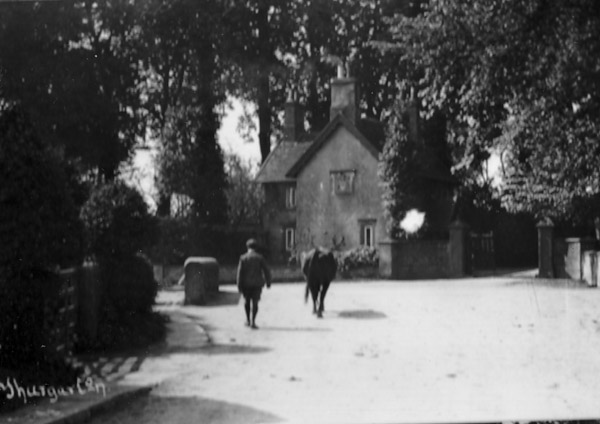
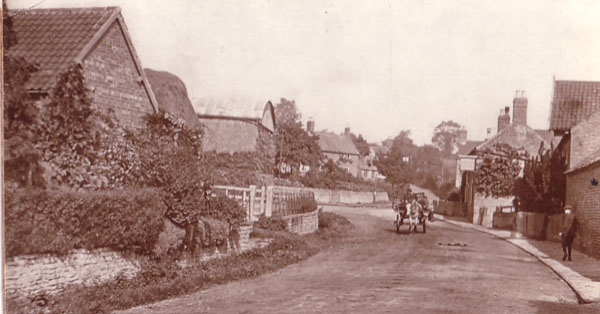
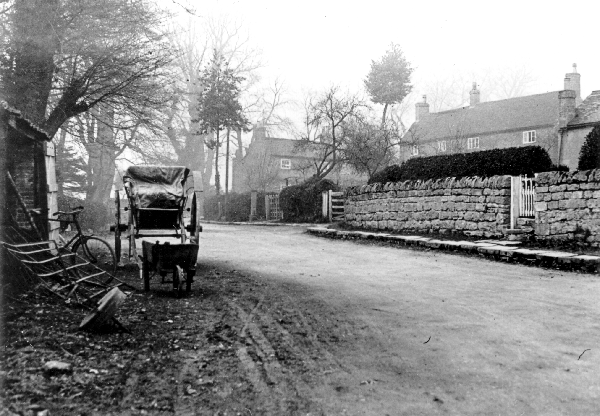
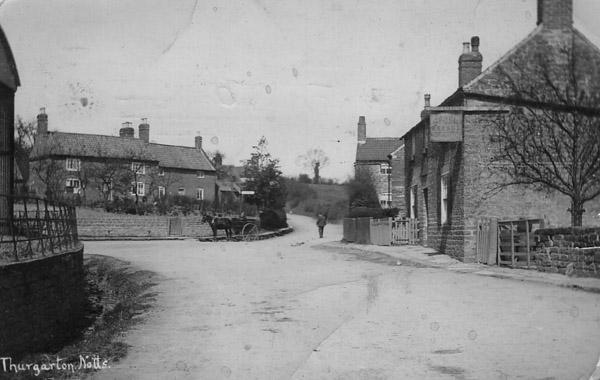
The main road through Thurgarton (the A612) is nowadays a busy highway and pedestrians attempting to cross  can grow old waiting for a gap in the traffic. The photographs and postcards below take us back to late Victorian and Edwardian Thurgarton.

A time when —

 — children could play in the middle of the road

3

— and a farm lad could take his time driving a cow down the highway.


A time when horse drawn carts travelled at walking pace although a pony and trap could travel at a fair lick especially coming down the hill — 

— but going up Thurgarton Hill, which was much steeper in those days, one had to pace oneself.

It was advisable to take  refreshment before starting the climb at The Coach and Horses —

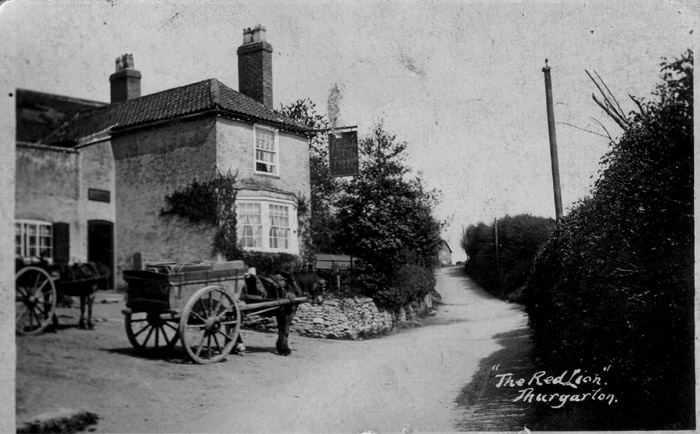
– – or stop halfway up at the Red Lion

— and if one  had over refreshed and suffered a breakdown then simply roll back down to the  smithy at the crossroads.

The earliest map of Thurgarton: land use in the parish

The earliest parish maps of Thurgarton were drawn up about 1730 to settle a land ownership dispute between Trinity College, Cambridge and the Cooper family.

The Coopers owned most of the north of the parish and lived in a Tudor mansion next to the parish church. In 1726 a rough sketch of the Cooper lands showed fields, woods and lanes (blue in map 1); their land was chiefly low hilly country of heavy clay soil extending down to the escarpment of the Trent Valley. They also leased much of the Trinity College land and acted as Lords of the Manor.

Trinity College Cambridge had been granted the village and southern half of the parish by Henry VIII. The 1731 map of Trinity College land (white in map 1) included not only village buildings, gardens, fields and lanes but also the names of each householder and the land that they rented from the college

Combining these two maps provides us with the only detailed pre-enclosure map of Thurgarton parish.

Map 1 Thurgarton parish c 1730 ( click on image to enlarge)

parish early 1730

Land usage in Thurgarton

The field names and layout provide some insight into land usage not only in 1730 but also for the preceding centuries for many of these 18th century field names can be traced back to the early Norman period in the land grants of the register or cartulary of Thurgarton Priory indicating that the basic pattern of land usage in the parish had not changed for at least 500 years.

Map 2  Basic land use in Thurgarton parish  (click on image to enlarge)

land usage


 1 Wooded parkland in the north (green in map2) – Overwood, Bankwood, Parkwood, Southwood, Youngwood.

A park at Thurgarton was part of the endowment grant by Ralph Dayncourt to Thurgarton Priory which he founded in c 1130. This was probably a deer park and sections of a ditch and bank , remnants of a possible deer fence and  a deer leap, can still be seen on the northern boundary of the parish.

In 1536 the Prior of Thurgarton sold timber from ‘his park at Thurgarton’ to the Duke of Rutland to rebuild Belvoir Castle. The contract describes the extent of the park which appears to have covered most of the north of parish and was evidently heavily wooded given the size of the timber contract – 1200 large oaks over 10 years.

Mediaeval wooded parkland was a valuable asset and besides hunting and timber it also was a source of fuel for domestic hearths and for small scale industrial furnaces; charcoal and tile making are both recorded in Thurgarton. In winter fodder for livestock included woodland leaves and pigs were allowed to  forage for acorns and roots. The villagers collected woodland plants and berries to supplement their diet or for medicinal use.

‘The Park’ persists in modern Thurgarton but has shrunk to an area of new houses and adjacent fields to the west of the church.


 2 Assart ( yellow in map 2) –Thwaite, Intake and Riddings

These names are typical of woodland which has been cleared for ploughing

(assarting) and which would have been incorporated into the open field system described below. These fields are named in mid-13th century land grants to the Priory which would be consistent with the increasing village population of this period and consquent need for more arable land. The mediaeval method of ploughing with ox teams along narrow strips of land gave rise to the typical  ridge and furrow patterns which have survived in many lowland parishes of Britain and are visible on field walking or in aerial photographs.


 3 Arable open fields ( brown in map 2) – Great field, Over field, Spital field.

These arable strips of plough land surround the village and lie on the well draining escarpment land. The land strips (selions) are clearly seen on the Trinity map (map 3) and aerial photos clearly show ridge and furrow patterns for Great Field and the assarted fields above.

 Map 3 Trinity estate with arable strips coloured in two tone green 1730 arable strips

 The pattern of arable fields is consistent with a three or four field rotational system of land use in the parish. Again several of these small strips of ploughland are mentioned in land grants to the Priory in the 13th century and earlier.

4 Pasture and meadow ( blue in map 2)- Nether Leys, Nether Meadow

The wet valley floor provided ideal pasture land and hay meadows and numerous small closes for livestock. Records indicate rearing of pigs, cattle and sheep and the name Coneygree indicates a rabbit warren (much prized by the early Norman lords and by modern Frenchmen ).

  Village plots and householders

  The village was owned by Trinity College and so appears on the college map.

Map4 Trinity College estate in Thurgarton, village highlighted.
1730 vill highlight copy

In this map houses and barns were denoted by letters ‘H’and ‘B’ ; in map 6 below the houses are in red, barns and outbuildings in brown, the school in orange and alms houses pink.

Map 6 Thurgarton village c 1730 ( click on image to enlarge)1731 village houses in red

 There were 27 named householders each with their house and outbuildings set in typically elongated plots of land – the croft.  Each householder is listed in map 7 below with a colour code for their corresponding house and croft.

Map7  Village plots with householder1730 villagers colour code 2The map also identifies the fields worked by each villager; they are shown in map 8 using the same colour code as in Map 7 above

Map 8 Land worked by each householder  – colour code as in map 7.

1731  16 small holders copy

 Each householder worked several widely seperated fields and strips of ploughland. This is more clearly seen if we simply look at one individual – John Brettle ( misspelt Bretton on the original map)

Map 9 Village plot and fields rented by John Brettle

1731 1 J brettle copy

 Thurgarton was a typical East Midlands parish with a single centrally positioned village surrounded by three or four large open fields worked on a yearly rotation system which would have been closely supervised by the villagers in their local Manorial Court. The parish stretched from wooded upland in the north to the well drained fertile escarpment on which stood the village and on to the the river valley with its pastures and meadows – an ideal balance of woodland, arable and pasture making the parish almost self-suffient for most of its needs.


This ancient pattern of land usage by the village community was to change dramatically before the end of the 18th century when  enclosure came to the parish  and will be the subject of another article.