School photographs from Thurgarton

Click on images to enlarge

c 1899-1900

Pupil’s names not known  The vicar of Thurgarton, Rev. Atwell  Baylay, appears in the first  three photographs – he is the bearded man in a cassock

Thurgarton school 1890s-2 enhanced (1)

c 1905-6

c 1905 2 copy

c 1911

d 1911-2 2

 c 19161916

c 1925e 1925  2

1935

f 1935 2

c 1940

g 1940

Late 1940sh late 1940s

1964

i 1964

Lessons outdoors in 1960sj 1960s 2

1970sk 1970s 2

Closure of school

school closure

The Squire of England

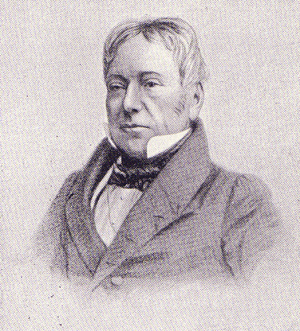
One of the more colourful characters to live in Thurgarton Priory, from 1813 to 1815, was Squire George Osbaldeston who in his heyday was lionised as the best shot, cricketer, horse rider and sportsman in England. We know this partly from his autobiography for the squire did not suffer from false modesty.

George Osbaldeston as a young mansquire osbaldeston as young man

Early life He was born in 1786 into a wealthy Yorkshire family who lived at Osbaldeston House near Scarborough. His father was M.P. for the town but died when George was six. As the only son amongst five children, he inherited a vast fortune. Aided by an extravagant and indulgent mother, he spent the next few decades in the usual pastimes of an English gentleman – sport and drinking, at which he excelled, and gambling and women, at which he didn’t.  His education was the perfect preparation for such a lifestyle. After expulsion from Eton and a ‘wild spell at Brighton’ he narrowly escaped being sent down from Brasenose College Oxford emerging three years later without a degree. His mother pushed him into politics and in 1812 he was elected the Whig MP for East Retford; he rarely attended Parliament for he found politics ‘ a great bore’ and stepped down at the next election in 1816 to concentrate on his great love – the sporting life.

Cricket Undoubtedly Osbaldeston was a gifted sportsman but his personality often attracted disputation.He played for the MCC, Surrey and Sussex and being both a gifted fast bowler and batsman enjoyed single wicket competitions that invariably involved large side bets. In 1810 Osbaldeston teamed up with the professional Lambert and played Lord Frederick Beauclerk and Thomas Howard. The squire fell ill and withdrew from the match but his opponents insisted it must proceed. Lambert deliberately bowled wide and to Beauclerk’s fury won by 15 runs. As a direct result the MCC changed the rules of cricket to ban bowling wides. Ill feeling flared again in 1817 when Beauclerk captained an England team against a Nottingham eleven which included Osbaldeston and Lambert. Both sides accused the other of cheating and such was Beauclerk’s influence that he had Lambert banned from the MCC.  The following year Osbaldeston was so enraged by losing a single wicket game to George Brown of Sussex that he resigned his MCC membership. Later he relented and reapplied for membership only to be barred by the vengeful Beauclerk.

Osbaldeston in middle age

squire osbaldeston middle age 2

The Horses  A physically tough slightly built man he was for many years a gentleman jockey riding  his own race horses. Inspired by the famous exploit of the 17th century highwayman ‘Swift Nick’ Nevison, who rode from London to York in 15 hours, Osbaldeston wagered 1000 Guineas that he could ride 200 miles within 10 hours. The race was held at Newmarket racecourse on a wet November day in 1831. The squire, dressed in purple silks and black velvet cap, set off at 7.12 am. and despite several rain showers, one fall and generous stops for brandy and food, achieved the 200 miles in less than 9 hours riding 28 horses. He then rode back to Newmarket, bathed and joined his friends for dinner.

162 years later on the same course, Peter Scudamore the champion jockey only just managed to beat the squire’s record although his breaks were much shorter and he spent more time in the saddle. On completing the 200 miles Scudamore declared himself exhausted and ‘laid himself carefully on the ground for a massage’.

In 1836 the squire was suspected of deliberatly holding back his horse Rush at  Doncaster so achieving a favourable handicap for the following race meet at Heaton where he won easily. He had of course backed himself heavily at Heaton including a £200 bet with Lord George Bentinck. His lordship was slow to settle and when Osbaldeston demanded his winnings Lord George declared “ I’m surprised you ask for the money for the affair was robbery’. Accused of cheating Osbaldeston demanded satisafction and so the Squire and the Lord met at dawn, pistols drawn, on Wormwood Scrubs. Unlike his opponent Osbaldeston was a crack shot but his lordship’s friends had seemingly negotiated a compromise and both parties missed their mark.

Hunting foxes and women.

Hunting was the squire’s other great passion and for nearly 30 years he spent a fortune   moving from one famous hunt to another: 1810 the  Burton, Lincolnshire; 1813 the Muster’s pack (now the South Notts); 1815 the Meynall and Atherstone, Derbyshire; 1817-24 and 1823-27 the Quorn, Leicestershire; 1827-34 the Pytchley, Northants. Each move involved the enormous expense of purchasing the Mastership which included the running costs of stables, kennels and men and  renting a gentleman’s residence for the season.

Thurgarton Priory with stables on left

aerial church and stables copy

During his time in Nottinghamshire (1813-5) he rented Thurgarton Priory -“Thurgarton was a pretty good house but I was obliged to build stables as well as kennels , a very expensive business”. However Osbaldeston was not impressed by the hunting, describing the countryside as“very bad and inconvenient for hunting, as the River Trent is so wide and deep that hounds and horses must be taken over in a boat.” During his time at Thurgarton the squire was bitten by a hound that might have been rabid: “he was seperated from the pack and I watched him daily (for a year) with the greatest anxiety convinced that if he did go mad I must die of that horrible disorder, hydrophobia”.

The  squire’s success at hunting the fox was not mirrored in his pursuit of women. When in Lincolnshire he vigorously courted the recently widowed Lady Munson but she went to ground and married Lord Warwick. A Miss Green of Lincoln provided some comfort but she quietly left the country on the birth of a son reputed to be the squire’s. At one county ball he was said to have seduced both the daughters of the house in one evening. True or not such stories about the squire’s hunting exploits on and off the field only fed his reputation and no doubt grew in the telling. More certain are accounts of his petulance and short temper that led to numerous disputes and to his frequent change of hunts.

The Old Squire

Finale

Osbaldeston’s lifestyle especially his gambling eventually exhausted even his considerable fortune. Overall he lost about £200,000 on horses and in 1848, to settle debts of £167,000, he sold his estates for £190,000 and an annuity of £10,500 pa for life. In such reduced circumstances in 1851 aged 65 he married a rich widow, Elizabeth Williams, and lived in her house in Regent’s Park until his death in 1866.

All the major newspapers of 1866 printed lengthy obituaries of “The Squire of England” celebrating his many feats of sportsmanship but mixed into this praise of a legend were more bitter memories and accusations of ungentlemanly conduct.

Squire George Osbaldeston belongs to the pages of Henry Fielding’s novel Tom Jones but he lacked that hero’s charm and generosity  – there was too much of the snappy Yorkshire terrier in him.

Sources

1 George Osbaldeston/E.D. Cummings, Squire Osbaldeston: His Autobiography, John Lane, London, 1926

2 http://www.oxforddnb.com/view/article/20860?docPos=1&_fromAuth=1

3 http://www.independent.co.uk/sport/racing-scudamore-rides-in-pursuit-of-the-squire-sue-montgomery-on-the-enduring-ability-of-a-former-champion-1509663.html

4 http://www.nottshistory.org.uk/portland1907/portland6.htm

5 Obituaries from –The Times, The Era, Glasgow Herald , The Derby Mercury


The Surrender of the Augustinian Priory of St. Peter, Thurgarton

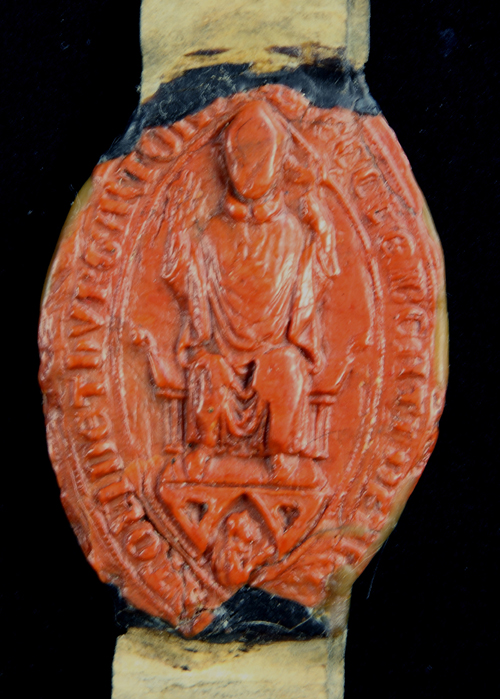
The wax seal of St. Peter’s Priory, Thurgarton showing a seated figure holding a key.

On Friday 14th June 1538, the chapter house of the Augustinian Priory of St. Peter in Thurgarton witnessed a very public and stage-managed ceremony, the surrender of the priory to the crown (1) . One can picture the scene.

On one side the Prior, John Berwick, and his eight fellow canons gathered together for the last time. The chapter house was the room where they and previous generations of canons had regularly met to discuss Priory affairs but on this Friday there was only one item on the agenda – the dissolution of their house.

Dominating the room stood Dr. Thomas Legh and William Freman, commissioners appointed by Thomas Cromwell to enforce the surrender of the monasteries. They travelled with a retinue of clerks and servants, some probably armed to suppress any dissent.

A third group present to witness the surrender included prominent members of local society: Thomas Markam, knight; Henry and James Hurley; and John Catcher. Also present were “many others” who may well have included local villagers and lay brothers of the priory, curious and anxious to learn of their fate under the new regime.

The document of surrender was probably read aloud and all would have heard that the Prior and his canons acknowledged King Henry’s supremacy in the church and unanimously and voluntarily transferred the priory with all its lands, property and rights to the king in perpetuity.

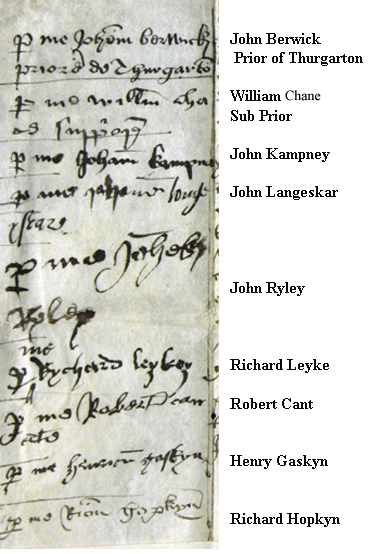
Document of Surrender of Thurgarton Priorysurrender document and sealStarting with the prior and then the sub-prior each of the canons signed the surrender document along its left margin. The priory’s seal matrix was then used for the last time. The red wax imprint was fixed to the bottom of the document and the matrix handed over to the commissioners.

Close up of signatures of prior and canons.

All the canons received pensions for life from the crown. Prior John Berwick received £40 pa together with Fiskerton Hall with its outbuildings, garden, and tithe of hay from two meadows. William Chane the subprior received £6 13s 4d pa and the other seven canons each received £5 pa.

Thousands of  religious men and women now had to adapt to a new life outside the cloister. The less fortunate became vagrants, some  took up posts in the new Church of England and others lived on their pensions.  Numerous pensioners  sold their pension rights  and by the late 1540s  county commissioners were appointed to sort out the  chaotic pension scheme.  Richard Hopkyn and Henry Gaskyn, whose signatures appear at the bottom of the surrender document (see above), complained that their pensions were in arrears and Hopkyn had purchased Robert Cant’s pension for £13 6s 8d.

So ended over 300 years of  the religious  life in Thurgarton.

The Wider Scene

The suppression of the monasteries was driven by new reforming ideas in religion, by Henry VIII’s need for a son and by the ever burgeoning royal expenses.

In the early 1530s many Englishmen accepted the need for modest church reform but the vast majority held firmly to their old traditional Catholic beliefs. More radical ideas from Europe were gathering support in England where reformers were especially critical of the great wealth, secular power and supposed immorality of the monasteries.

The rich monastic orders were an obvious target for Thomas Cromwell’s money raising schemes. Ever the efficient administrator he organised a complete survey of church property together with an inquiry into the moral standards of each house. Cromwell’s  commissioners included the dreaded trio of  Legh, Layton and London; they travelled throughout England and Wales and condemned virtually every house as dens of sexual depravity and immorality. Dr Thomas Legh was so unpleasant that even his fellow commissioners complained of his offensive behaviour. Thurgarton was inspected in 1536 by commissioners Legh and Layton, who reported that “ten brothers were guilty of unnatural offences, the prior had been incontinent with several woman and six others with both married and unmarried women and that eight canons desired to be released from their vows” (3).

Individual monks may well have lapsed but such crude exaggerations were part of Cromwell’s anti-monastic propaganda campaign. Cromwell’s detailed inventory enabled him to prevent the houses from hiding or selling off any valuable items.  It also identified those Abbotts and Priors who might prove difficult and should be ‘persuaded’ to resign. The “incontinent prior” of Thurgarton in the 1536 survey was Thomas Dethicke who resigned soon after – he was rapidly replaced by his sub-prior, John Berwick  who surrendered the house 16 months later;  the generosity of his pension strongly suggests that he was more than cooperative with Cromwell’s commissioners (4).

The  break from Rome and papal authority was precipitated by Henry’s need for a legitimate male heir and hence his divorce from Katherine and marriage to  Ann Boleyn. In November 1534 The Act of Supremacy and the Treason Act declared Henry VIII to be Supreme Head of the Church and anyone denying his claim was guilty of treason.

In March 1536  parliament passed an act for the dissolution of all religious houses with an annual income of less than £200. The suppression of the smaller monasteries provoked a great northern rebellion, the Pilgrimage of Grace. Forty thousand men led by the unlikely figure of lawyer, Robert Aske, demanded the removal of the evil councillors who surrounded the king (especially Cromwell and Cranmer) and the restoration of their traditional religion. The crushing of the northern rebels in 1537 was the end of any organised resistance and appears to have spurred Henry and Cromwell on to an even more aggressive phase of suppression.

The larger monasteries were now targeted, without any consultation with Parliament;  Cromwell and his commissioners simply used the time honoured method of the enforcer- the monks were made an offer they could not refuse. Those who voluntarily transferred all lands and property to the crown would receive a pension for life and those who resisted were traitors;  the canons of Thurgarton were faced with this stark choice of quiet acquiescence and a state pension or resistance leading to a traitor’s grisly end. Only a few months earlier the Prior, two monks and four lay brothers of Lenton Abbey in Nottingham were executed for dissent.

Not surprisingly the vast majority of religious houses surrendered voluntarily and so Cromwell engineered the largest peacetime land grab in British history.

Dividing the Spoils

An army of workmen and clerks, controlled by Cromwell’s Court of Augmentation systematically plundered the religious houses. Chapels and shrines were stripped of their valuables. Lead from the roof, timbers, masonry and even nails were recycled and sold; monastic sites came to resemble reclamation yards. Thurgarton’s many chapels and its shrine to St Ethelburga would certainly have suffered the same fate but the fabric of the buildings may have been preserved for the new owner.

Anxiously awaiting events was a rich Londoner, one William Cowper. On 5th June, nine days before the Priory’s surrender, he had written to Wriothesley  (Cromwell’s right hand man) that he planned to go into Nottingham for “ the kings surveyors will be there and I am in haste preparing for them for Thurgarton

The king’s surveyors or commissioners, Legh and Freman, had set out from Halesowen on the 12th June, probably arriving at Thurgarton late on the 13th where with minimum delay they received its surrender on the following day. On the 16th June, Dr Legh wrote from the “late priory of Thurgarton” to Wriothsley “I have received your letter at Thurgarton concerning Cow(o)per and accomplished the effect thereof”. It seems probable that William Cowper was present at Thurgarton around the time of its surrender when he had agreed terms with Legh for the purchase of the priory.

Cowper’s haste may be explained by his knowledge that there were other interested parties.  Anthony Birks of Lye, Kent had hopes of acquiring Thurgarton; on 19th August 1538 he wrote to Wriothsley “I beg favour to my Lord Privy Seal (Cromwell) that so many houses of friars being now in suppressing he may help me to one of them as it standeth. The signed bill which the King gave me for Thurgarton Abbey came to no effect as you know”.

On 15th March 1539 the formal contract of sale of Thurgarton Priory was verified. The priory buildings and land in the north of the parish were sold to William and Cecilia Cowper for £510 6s 8d plus the remainder of the 30 year lease which they held on the manor of Ewell and the rectory of Nonsuch in the county of Surrey. One of King Henry’s great projects at this time involved the acquisition of a large expanse of land in Ewell and the surrounding parishes to create the magnificent new royal hunting park and palace at Nonsuch. The Cowpers’ leasehold in Ewell and Nonsuch, lands which were central to the king’s plans, probably clinched the deal (5).

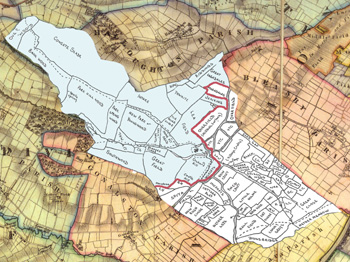
Not all of Thurgarton went to the Cowpers; the village and the southern half of the parish were donated in the 1540s to Henry’s great foundation, Trinity College Cambridge, along with the rectory and living of Thurgarton. The Cowpers leased the college lands in Thurgarton and over the following three centuries there were frequent disputes between the Cowper family and Trinity College regarding land ownership, tithes and rights to timber(6).

Thurgarton parish 1730s– Cowper land in blue and Trinity College land in white

Thurgarton Priory, founded c 1130 underwent a major rebuilding in the early English style in c 1230 and the new church was said to have rivalled Southwell Minster in scale and magnificence. The picture below is an attempt to reconstruct the west front of the new Priory.

Reconstruction of West Front of Thurgarton Priory

priory reconstruction

After the surrender the priory church continued as a parish church but most of it was dismantled and reduced to a single short nave; only part of the west front was preserved together with the northwest tower. Of the secular buildings the kitchen survived as did the ground floor of the west range on which the Cowpers built a new Tudor mansion seen in Buck’s print below.

Buck’s print of Thurgarton Hall 1726

Buck's print 1726

In 1770 the Tudor house and kitchen were demolished to make way for the present brick mansion and in 1854 the church which was “in a very poor state” was restored by the Nottingham architect T. C. Hine who added a north aisle and chancel to the old parish church.

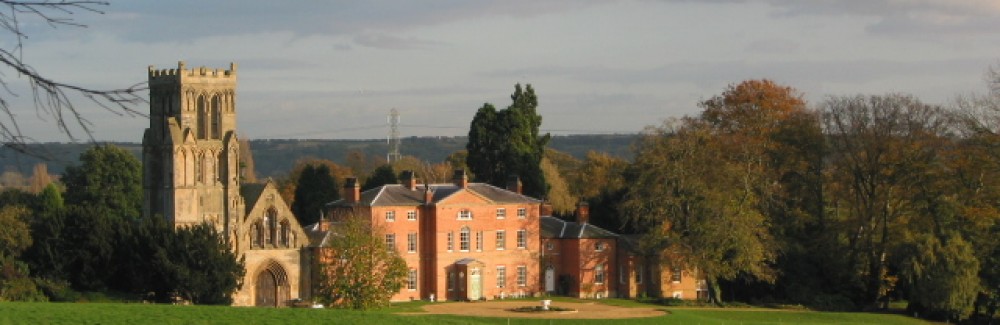
Thurgarton today- parish church and Georgian house

Thurgarton Priory todayThroughout England and Wales a new class of men built their grand houses on the ruins of demolished monasteries. Some like William Cowper were wealthy city merchants who aspired to the life of their social betters – the landed aristocracy. Within one generation almost a third of English land changed hands and that backbone of English county society was born – the landowning Anglican gentleman.


References

(1) National Archives, E 372/241 , Surrender of Thurgarton Priory 1538


(2) http://www.british-history.ac.uk/report.aspx?compid=40083


(3) http://www.british-history.ac.uk/report.aspx?compid=40092


(4) Trevor Foulds, The Thurgarton Cartulary (Stamford 1994 ) p.ccvi


(5) Letters and Papers, Foreign and Domestic. Henry VIII, J Gairdiner (Ed.) Vol.13, Parts 1 and 2, June and August 1538.


(6) Trinity College Archives, Box 37 (on Thurgarton)


The second oldest sheep wash bridge in England

For many centuries sheep have been washed in the early summer, a few weeks before shearing, to clean the fleece of the dirt, grit and grease which inevitably build up over the winter months. It should not be confused with sheep dipping which is a more recent practice aimed at controlling parasitic infestation.

Sheep washing at Priory Farm, Thurgarton in the 1940s.sheepwashing 1950s priory farm

This is the hard way to wash a sheep, but then there is no easy method for sheep washing has always been extremely laborious and wet for both animal and man. The photograph above, taken in the 1940s, shows Charlie and Frank Allwood  of Priory Farm in Thurgarton using a large tub and much elbow grease to wash their flock of 30 sheep. According to Brenda, Frank’s daughter, “it took them all morning and by the end they were exhausted, soaking wet and stank of sheep and disinfectant”.

Sheep washing on a larger scale usually involved driving the flock through a fenced off section of running water. Many parishes had a traditional site for sheep washing, most were on local rivers or pools but some villages used the mill pond or even a suitable stretch of a seaside beach. The men would spend hours waist high in cold water and each animal had to be totally immersed and scrubbed; not surprisingly sheep washing was not popular with the men although apparently much enjoyed by spectators who eagerly anticipated accidental dunkings or watery chases.

Many modifications were employed to keep the men relatively dry. Some used raised wooden walkways or stone parapets which enabled the men to control and wash the sheep below with long handled crooks and brushes.

An alternative approach was a central pulpit-like structure in the water in which a man could stand without getting soaked. This method was used in Epperstone, the parish west of Thurgarton. The photograph below, taken in the late 1940s, shows the remains of a wooden ‘pulpit’ in the centre of a stream immediately below a bridge. The pulpit could accommodate one man and was sufficiently tall and water tight to keep him dry as he washed the sheep which were driven past him through the stream. Thurgarton’s sheep wash was based on this model but was stone built and had a number of  technical improvements.

Sheep wash bridge at Epperstone in 1940s

sheepdip5 epperstone

The Sheep wash bridge at Thurgarton

When we first moved to Thurgarton we were proudly informed that it possessed the second oldest sheepwash bridge in England; admittedly a modest boast but a safe one for who would bother to compete for such an honour. The bridge carries an old trackway over a small stream, the Thurgarton Beck or Dumble, a mile to the north of the village.

In the mid 1940s the Boots Pure Drug Company purchased the Thurgarton Priory Estate for an agricultural research centre headed by Sir Jack Drummond  He took a great interest in the history of the parish including the sheepwash and in May 1948 wrote the following letter  to Country Life.

Sir Jack Drummond’s letter and photograph in Country Life, 21st May, 1948

(click on image to enlarge)

drummond letter

The local resident referred to in the letter was Bill Atkins a local farm labourer who remembered the sheepwash being used in his youth by farmers from the surrounding parishes of Halloughton, Gonalston and Lowdham.

Restoration

So began an early exercise in industrial archaeology and restoration; the sheepwash was in a sorry state as witnessed by photographs taken before reconstruction.

Views of sheep wash bridge, Thurgarton in 1948 before restoration.sheepdip before restoration 1940s

sheepdip3 final 2

The restored sheep wash bridge was completed by 1952 and was based on the plan below ( click on image to enlarge)

sheepdip 6 diagram of working dip

Restored sheep wash bridge showing basin , pulpit, steps and water spout 2008

sheep wash today final 2

Date of the sheep wash

Further evidence for the date of the sheepwash was uncovered in the pages of the Journal of the Royal Agricultural Society of England of 1875 (Vol 2 page 330) where a note from Mr Milward of Thurgarton reported that “spout-washing was established at Thurgarton at the end of the last century and in combination with a wooden T-like instrument to work the sheep’s back”.

The sheepwash was evidently in use in the late 18th century and from the archaeologists opinion recorded in Sir Jack’s letter may have originated in the mid-17th century.

So what of Thurgarton’s boast that it possesses the second oldest sheep wash bridge in England? Maybe we should be cautious but I see no reason to change our proud claim – unless someone out there knows better.

The sheep wash today

The bridge is beginning to deteriorate. The top half of the pulpit is missing and  brambles and bushes are invading the basin but it remains one of the parish’s favourite features lying half way around a 3 mile circular walk from the village.

Thurgarton sheepwash bridge ( click on image to enlarge)

sheep wash final 2One can while away many minutes, sitting on the bridge, puzzling how the system worked in detail — Step 1 close sluice gate1 so forming a large pool upstream — Step 2 catch your sheep and pen them securely–Step 3 adjust both sluice gates to half fill basin and to control flow of water through spout –Step 4 drive 3-4 sheep into water and scrub — and so on —

— or you could just enjoy the scene.

sheepwash view final 2

Cheerio from Thurgarton the home of clean sheep

dick thornton with sheepflock on beck st final 2

Thurgarton Open Air School or The Home for Recovery of Phthisical Children of School Age at Thurgarton.


The Whitehouse in Thurgarton was a purpose built house for children recovering from tuberculosis. It was opened on St. George’s Day 1910; at the ceremony (see photograph below) were the leading lights of the local founding committee – Mrs Upton of Thurgarton Priory, Bishop Hoskyns of Southwell (in top hat) and the vicar of Thurgarton, Rev. Atwell Baylay (with beard). The boy on crutches is Fred Warrener whose brother Percy lived for many years in the cottage on Bleasby Rd. now called Warrener’s Cottage.

Opening ceremony of the Whitehouse, Thurgarton on 23rd April, 1910.

white house opening 1910-ms upton, rev baylay,bishop and warriner lad with crutches

The home was closed soon after the outbreak of World War 1. It reopened on July1916 when the Nottingham Voluntary Care Committee bought the house and installed a matron and assistant to look after several children from the city who suffered from pulmonary tuberculosis. In August 1916 Dr Philip Boobyer, M O for Nottingham City backed the scheme and in September the City Health Committee voted to take over the running of the home as part of their anti-TB scheme. In the first decade of the 20th century many boarding schools for consumptive children were built; these open air schools had been popular in Germany for several decades but Britain had been slow to adopt the practice.

On 23rd September1916 Dr Boobyer and Dr. Muriel Bywaters met for an inspection of the Thurgarton house. Muriel Bywaters from the Board of Education in Whitehall spent many years travelling the length of England as the government’s chief inspector of schools for tuberculous children.

Her report describes the house as standing on the edge of the village in ¾ acre of land amidst open fields. The ground floor consisted of a dining room, matron’s sitting room, kitchen, pantry, a corridor with pegs for coats and hats, and a single lavatory with a wash basin. On the first floor were matron’s bedroom, two dormitories with room for 4 and 5 beds, a servant’s room and a bathroom with one bath and two toilets. Lighting was by candles there being no electricity or gas supply and no telephone. Water was obtained from a 60ft. well with a pump in an outside washhouse.

The Whitehouse Thurgarton

convalescent home

Dr. Bywaters made several recommendations: an outdoor classroom, larger windows and better ventilation, more toilets and a better bathroom. These alterations were designed to ensure sunlight and fresh air for the children and were essential to the ‘open air’ treatment of tuberculosis.

The open air approach to tuberculosis was based on a belief in the recuperative powers of a prolonged regime of as much exposure to fresh air and sunlight as possible, an abundant diet, freedom from all excitement with repose of mind as well as body and regulated exercise .

The staff, which consisted of a matron, an assistant, a cleaner and gardener, cared for 4 boys and 5 girls aged 6 to 11 years all suffering from early pulmonary tuberculosis. The matron, Miss Stebbings, had herself only recently recovered from tuberculosis having spent 6 months in a sanatorium. Dr Bywaters was concerned by her persistent cough, husky voice and frailness and doubted her physical fitness to cope.

Mr Holmes the gardener at the WhitehouseMr Holmes gardner at the White House


The children’s daily routine included long periods of rest with bedtime from 6.30pm till 8.00 am. School lessons extended from 9.30 am to 12.30 followed by light exercise in the afternoon. They were bathed twice a week and weighed once a week. Dr Bywaters was very concerned that the older boys were mixing with the girls and recommended that the home should be exclusively for girls.

An open air garden shed/classroom was built in March 1917 and a new teacher appointed to teach the 3 boys and 7 girls now living at the home. There was evidently a problem in keeping ladies in this post which paid £50 with free board and lodging – the succession of incumbents included Miss Sarah Parkin in 1917, Miss Freda Barnard in 1918 and Miss Beatrice Neate in 1919. The children’s education was a problem mainly because the teacher had to spend most of her day on nursing duties and had little time for lessons; Miss Neate wrote a letter complaining that she could only “play at teaching” and left shortly afterwards to be replaced by a Miss Florence Sharpe.

In May 1919 Dr Bywaters visited the Thurgarton home once more and found many inadequacies. The windows were unchanged. School equipment was poor and the garden classroom leaked and could not be used for most of the winter. The water supply from the well was unreliable and water had to be carried from a neighbour’s well – the children were not bathed but strip washed. Even so she found the children happy and well cared for. She noted that each child took a daily spoonful of Virol – a popular bone marrow extract for children and invalids

In 1919 Nottingham City started to convert Bulwell Hall into a large children’s sanatorium/school and in October 1920 the Thurgarton home was closed and the children transferred to Bulwell Open Air School. Work on Bulwell Hall was still in progress and in March 1921 an inspection by the ever vigilant Dr Bywaters found awful conditions – 40 children living in dirty rooms, inadequate toilets, poor furniture and thin blankets. The standard of teaching was poor and one teacher had active tuberculosis and was unfit for duty.

A repeat visit late in 1921 fortunately found vast improvements at Bulwell and a much happier home for the children. The Hall changed use to an approved school for boys in 1937 but at the outbreak of World War 2 was used firstly by local regiments and later as a camp for Italian prisoners. It was finally demolished in 1958 but the surrounding estate survives as Bulwell Wood Park.

The Whitehouse at Thurgarton survived – it was converted to a private dwelling and still stands on the north-eastern edge of the village.

Sources

National Archives ED 32/173 notes from Nottingham Corporation on Thurgarton Open Air School 1916-1921.

http://www.nottsheritagegateway.org.uk/people/moh.htm a brief biography of Dr. Boobbyer.

http://www.jstor.org/pss/25430195 obituary of Dr. Bywaters in B.M.J. Dec.1978 who died at the age of 95.

http://www.faqs.org/childhood/Me-Pa/Open-Air-School-Movement.html – notes on open air schools in Britain.

WW2 Evacuees in Thurgarton

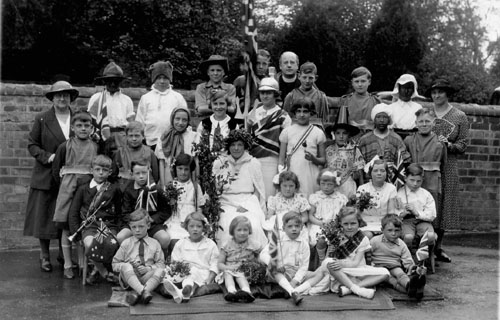
The photograph below shows Thurgarton school celebrating Empire Day in 1937. The school had 30 pupils and two teachers in 1937 but within a short time the village and its school would play host to a large influx of evacuees.This article tells the story of the village and its evacuees two of whom have left a record of their memories of life in wartime Thurgarton.

Prominent in their accounts are the school’s headmistress Mrs Beech (far left) and her assistant teacher Miss Fletcher (far right) and the vicar, Rev. Halstead (centre back row).

Empire Day Thurgarton School 1937
In the 1930s the threat of war and the fear of urban bombing  drove the government to prepare detailed plans for the mass evacuation of major British cities and towns. The plan, code named ‘Pied Piper’, was prepared well in advance of the outbreak of war and the order for evacuation was given on the last day of August 1939,  3 days before the declaration of war with Germany. Within the week nearly 3 million children with 100,000 guardians (mostly teachers) were dispersed by coach and train into the countryside.

Given the scale and speed of ‘Pied Piper’ some confusion was inevitable but it was undeniably a triumph of logistical planning. Newspaper reports describe cheerful parents and excited children but such propaganda hid the truth of the trauma of painful family separations. Children some as young as four underwent a lottery of fostering. Many evacuees have told their stories; some describe years of abuse and misery but others recall happier times – of an idyllic English village childhood.

On 4th September 1939, nearly forty evacuees from Sheffield arrived in Thurgarton. The school log book for 13th September records the new school enrolment as – children from Thurgarton 28, Sheffield 22 and Nottingham 2 with two extra teachers from Sheffield.

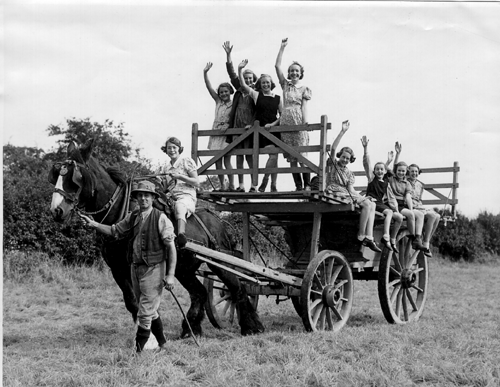
Sheffield evacuees on Mr Allwood’s hay cart, Priory Farm Thurgarton,1939
The immediate threat of mass bombing did not materialise and many of these early evacuees went home – only 7 children from Sheffield remained at Thurgarton. However the threat became all too real after the fall of France in June 1940 and a further wave of evacuation brought 18 children and 1 teacher from Southend to Thurgarton.

The school log book for the 3rd June 1940 records their arrival and billeting. On 5th June the school reopened and all new children underwent medicals which included the inevitable search for nits.

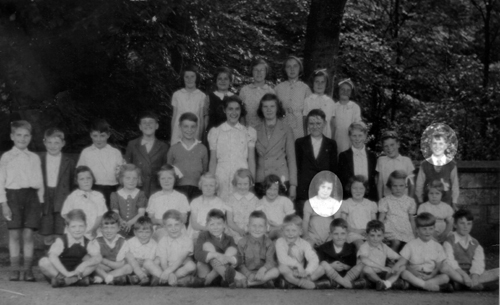
The enrolment lists 43 children -from Thurgarton 16, Nottingham 2, Sheffield 7, Southend 18.- most were to spend the next three years in the village. Two evacuees from Southend, Ken Lambert and Gladys Totman, have recorded memories of their time in Thurgarton and what follows are edited extracts from their memoirs.

Thurgarton School 1940 – Ken Lambert and Gladys Totman highlighted
 

 Edited memoirs of Ken Lambert written in 1992

In June 1940 my brother Peter and I were taken by our parents to Wentworth Road School in Southend to board a double-decker Corporation bus. Our names were pinned on us, we were given a gas mask in a cardboard box, a small bundle of clothes, and a bag of sandwiches. Our parents waved a tearful farewell and off we went to the Central Railway Station. All we knew was that we were going somewhere safe away from Hitler and his bombs; we didn’t know where, neither did our parents, and our teachers were not allowed to say.

To me it was an adventure. In the evening we arrived at Southwell Station and were surprised to see chickens running on the platform. There seemed to be hundreds of children from all over Southend. We were taken to different parts of Nottinghamshire and what a strange place it seemed. People spoke differently, narrow hilly country roads, farms (never seen a farm before) and mini-towns called ‘villages’. There was no village name sign – they had all been taken down throughout the country so Hitler would get lost.

At last we found ourselves in Thurgarton C of E School and were lined up in the playground and the billeting officers arranged with the village folk to take us into their houses. Peter and I were taken in by Mr and Mrs Perkins who lived in Bleasby Road. What a strange house*. It was long and narrow built on the edge of the road and appeared to have no windows – until we had gone round the back , which was the front of the house. There was a big garden at the back of the house and a large orchard with tall stinging nettles. There were pigs and chickens and Mrs Perkins took us to feed them each morning before going to school. We didn’t see much of Mr Perkins who worked very long days, six days a week, looking after the village hedges and ditches. Mrs Perkins tried very hard to look after us but I am afraid we proved too much of a handful and we had to move on. She was very upset. She was a lovely person and always took an interest in us right up to her death in 1972.

We were taken in by Mr and Mrs Atkin who lived at Hill Farm Cottages and had three daughters and a son. The oldest daughter was a teacher in Nottingham and married with a daughter – they visited each month and brought some sweets. The second daughter Lily lived at home. She was a dressmaker and looked after us; she spent a lot of time taking us for walks, blackberry picking, collecting dead wood, feeding chickens and supervising all the daily tasks we had to do. At potato picking we would hide some big ones in the hedge which we collected later and baked on a fire.

Kath and Lily Atkins and friends on a motorbike in 1930s
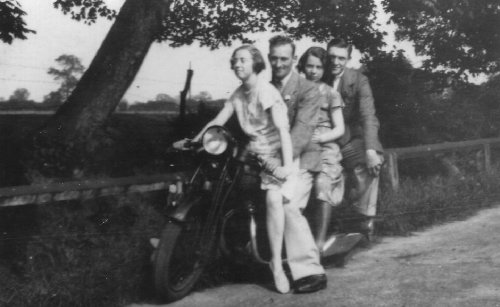
The youngest daughter, Kath, was a dashing young lady in army uniform; on leave visits she used to make us jump “ Come on you lads, get cracking” –and we did. The son Bill was a prisoner of war**. I’ll never forget Mrs Atkin waiting for the post lady for news of her son. We could see and sense her pain as time passed by but the brave lady always had a smile for everyone. She worked fit to drop and only ever seemed to leave the farm on Sunday morning to go with us to church.

I liked Mrs Beech the headmistress and Miss Fletcher; the school was so crowded that we often had lessons in the barn in the farmyard next to the Coach and Horses. Mrs Beech was the church organist and we joined the choir – this was our first time in a church or in a choir.

Out parents came to see us with our baby sister Betty born in July 1940. Someone lent us an old large doll’s pram and my sister was taken around the village in it. After my parents left one of the village girls teased me about my sister being in a doll’s pram and I was rude to her – to my cost. Mrs Beech gave me the cane on my backside in the playground in front of all the children. I don’t think it did me any harm.

Ken and Peter Lambert with baby sister Betty in doll’s pram at Thurgarton station


In the summer of 1943 our father took us home to Southend. I didn’t really want to go but my father and mother wanted to be a complete family again. On our return we were shocked to find the schools were closed. Many more air raids took place with many nights spent in underground shelters. All the empty houses in the streets filled with troops ready for D-day.

At the end of the war the town came alive, the lights came on again and the Pier and the Amusement Park were handed back by the Navy and the beaches reopened.


Edited memoir of Gladys Totman written in 1995


Evacuation from Southend, June 1940.

There were many tearful partings. I was desperate not to go but had strict orders to look after my baby sister who was not quite 5 years old –I was 7. It was a big responsibility especially as we had no idea where we were going. We boarded the train in Southend at 10am and after a long journey got off somewhere in the Midlands and were dispersed by coach to various villages – our destination being Thurgarton.

We were assembled in the village school where the billeting officers handed us over to the people who would be our foster families for the duration of the war. My sister and I were allocated to Henry and Mary Poole (Hill Farm cottages) who had two children of their own, Jean and Kenneth.

Life at Hill Farm

On that Sunday the child population of Hill Farm grew from four to eleven. The farm was sheer paradise for us. There was always something going on – new calves and lambs, pink silky piglets in an old galvanised bath in front of the kitchen range, hunting free range eggs and picking plate sized field mushrooms or blue buttons on late autumn mornings.

We were all included in the farm activities such as haymaking, harvest, potato picking gathering blackberries, sloes and hazelnuts. At harvest time there was a school holiday and we all joined in; we rode on the huge carts which were fitted with extra attachments front and back to increase the loads. We carried big baskets of bread , cheese, apples and cold tea in quart beer bottles up to the men who worked in the fields well into the dusk.

Acorns were collected by the sackfull to supplement the pig’s diet and rose hips to make syrup for vitamin C. Once a year a pig was killed for food for the farm folk and other food sources included pigeon, rabbit, chicken, eggs, butter and cream and any amount of apples, pears , plums and damsons. We didn’t have sweets but didn’t miss them.

School

The head mistress was Mrs Beech, she was also the billeting officer and church organist. Miss E Fletcher taught the infants and juniors. There were only two classrooms at St. Peter’s School which were full for most of the war but we got as good an education as one could expect.

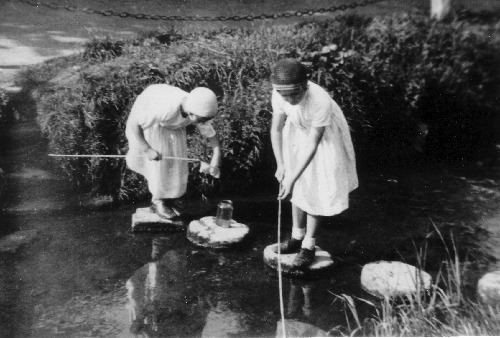
At school cricket and rounders were played and conkers were very popular and there were many heated contests in the school playground. The beck was a great place to catch minnows, sticklebacks and bullhead . In winter the stream was wild as the water boiled down from the hills bringing all sorts of debris. In summer we would pass through the schoolyard gate onto the path along the beck and pick fresh watercress from the clear water. Further down there were stepping-stones and the middle stone was wobbly and quite a few of us got an unexpected paddle.

Generations of Thurgarton children have fished the Beck
At school both girls and boys were taught to knit gloves and scarves for the troops as well as embroidery for the Red Cross. We also raised money with plays and concerts -we all had to help with the war effort.

Friday afternoon was a treat with Mrs Beech reading from The Wind in the Willows or Little Lord Fountleroy etc. and her voice would get decidedly croaky in the sad places and her hanky was in use on many occasions. Yet she would weald the cane when necessary.

Mr McLean the dentist visited twice a year to sort out our teeth. He parked his mobile surgery ( a converted showman’s caravan) in the field behind Bentley’s farm.

Once or twice a horsebox shaped vehicle arrived and parked opposite the school. We were taken in groups and put inside and told to wear our gas masks and then after the gas was released we had to take them off. I don’t remember how long each session took but only the children went in, none of the adults. We didn’t appear to suffer any ill effects.

St. Peter’s church with Thurgarton Priory in 1940s.
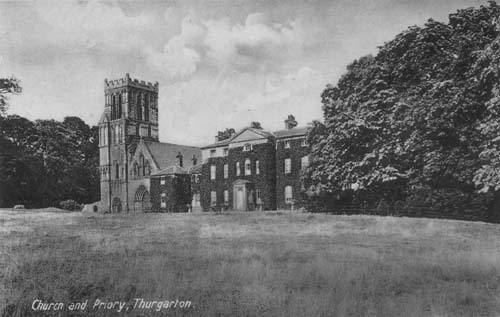
We all went to church on Sunday. The Priory next to the church was a convalescent home for wounded troops, Mrs Ransome lived there with a team of nurses. The troops filed into the front two pews of the church through the connecting door to the house. Mrs Beech the headmistress was the church organist and we all joined the choir.

The vicar, Mr Hallstead, was a real Bible thumper, more of a hellfire evangelist. I don’t know if he realised how we choristers took the mickey but he was a bit short and needed a wooden box to stand on to see over the pulpit. We used to chew our Psalm sheets into soggy balls of paper and catapult them at the convalescent troops – it broke up the monotony of the sermon.

Unusual Events

During our time at the farm I believe Coventry was badly bombed. I remember being taken from our beds downstairs to see the red glow in the sky – it seemed to burn for days.

We had a dreadful fright one day on the way home from school, we had just turned up the long lane to the farm when we saw a parachutist coming down – we thought the invasion had begun. All the men ran across the fields with anything to hand as a weapon to catch him. To this day I don’t know if he was caught. I had nightmares for weeks and started sleepwalking again.

In 1943/4 the kids were all agog when a team of American/ Canadians spent a few weeks test drilling for oil in a field behind Kathleen’s cottage – there is still a capped test hole there.

Later in the war a bomber crashed just outside the village, it had a full load of bombs and all the crew were killed. It was double summer time and both pubs were busy. The plane flew over, it sounded in trouble and then there was a huge explosion and the whole place shook. The pubs emptied in record time and the men ran up the drive to the Priory then across the fields to where a column of black smoke was rising. From snippets we heard it was very gruesome and a woman in a nearby cottage who had just given birth was saved because the blast went the opposite way. We were supposed to be in bed but with all the disturbances we sneaked downstairs and peered round the blackout curtains – we saw such a black cloud.

Life in the schoolhouse with Granny Webb

In 1942 the Pooles retired from farming and sold Hill Farm to Boots. We were all sad to leave the farm, some children went home to Southend but I and my sister were rehoused in separate homes in the village. I moved into the schoolhouse with Mrs (Gran) Webb, she had taken in many evacuees and had a scroll from the Queen praising her for her care.

The schoolhouse had one living room with a black range, a narrow kitchen, a pantry under the stairs and a dormer bedroom in which slept Kathy Povey, Stella and Shirley Swainson and myself. Gran taught us how to look after our clothes, to darn, sew on buttons and mend tears. She was not a young woman but she knitted garments to order including knitted stockings for the Miss Players of Nottingham (of the tobacco family) and the altar cloths for the church.

We all had chores to do for Gran. Before school we made the beds, washed up, peeled potatoes and once a week polished all the brasses and cutlery. Friday night was bath night in a tub in front of the fire. Gran took the News of the World every Sunday, she always did the crossword and fashion competitions but never won. We were allowed to read the music page where words and music were printed of the hits of the day. By Monday the newspaper had been cut into squares and relegated to the outside toilet threaded on a string on a nail. Not many houses had indoor toilets and by today’s standards the toilets were very primitive but surprisingly clean and hygienic – everything smelt of Jeyes Fluid.

There were many springs in the village – Granny Webb used water from her spring to bathe her eyes with a mixture of water and boracic to keep her sight clear for her knitting and crochet. Granny Webb would join her friends for a Guinness now and then either at the Red Lion or the Coach and Horses.

There were two walnut trees in the field opposite the Priory, we collected quite a few to take home but Granny Webb said we were ‘scrumping’ but she kept our secret because she loved them as much as we did. The dye from the green skins was a dead giveaway, it stained our hands dark brown and we were scared that Freddy Sharpe’s dad would see them- he was a special constable and we had a healthy respect for the law.

Granny Webb had a piano which we girls learned to play. It was used for all the functions in the village hall (the Hut ) being transported in Percy Fletcher’s trap down Bleasby Road with many volunteers pulling between the shafts.

Poor sister – they kept a pet hedgehog to eat the cockroaches

When we were separated my sister went to the Fletchers on Bleasby Rd where she was well cared for but for some unknown reason was moved on to one of the cottages next to the Coach and Horses. The cottage was overrun with cockroaches and they kept a pet hedgehog to eat them, they also had several tomcats which made the house stink. My father was in the RAF at Redcar and would call in regularly to see us. He was appalled when he next saw my sister – she was grimy, had a whitlow and a tooth hanging by a thread. He confronted Mrs Beech the billeting officer and created quite a stir.

Home to Southend

Every time my parents visited they would ask if we wanted to go home but the magic of the village was still alive and we stayed. By the time I had my 11th birthday in January 1944 I started to feel the need to go home. Mum and dad had moved into a 3-bedroom semi with indoor plumbing. The number of children at school was dwindling, the older children left and whole families were moving away.

The journey home to Southend was very strange, the train was jam packed with every allied nationality in uniform- I’ve never seen so many people rushing about. We stayed overnight in London and experienced our first air raid and saw bomb damaged buildings. We had a new school and for the first few weeks were teased about our accents – it was very daunting going to a large suburban school after years in a two class village school.

The strange thing was that we were 12 months ahead with our lessons.

We were now a complete family for the first time for 5 years – it took some getting used to.


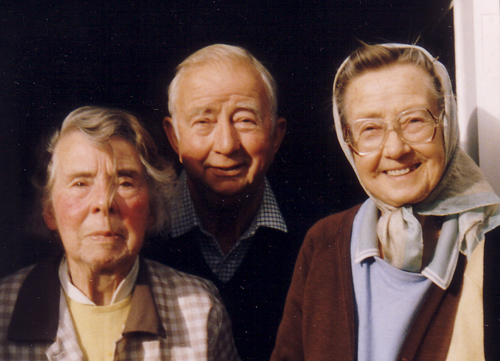
Both Ken and Gladys revisited Thurgarton many times and along with many other evacuees kept in touch with the village families such as the Atkins below.

Kath, Bill and Lily Atkin in the 1990s
 

* Sunnycroft Cottage , Bleasby Road – one of the oldest cottages in the village.

** Bill Atkin of the Sherwood Foresters was captured in Norway in 1940 and came home to a village celebration in 1945. The school children lined up in the playground to cheer him home as he marched down Beck Street from the station. Later over 200 villagers formally welcomed him home and celebrated with a day of games and a tea of cakes, strawberries and ice cream.

Sources

Ken Lambert’s memoirs are a brief account (3 pages) and a full copy is available from this site on request.

Gladys Knight nee Totman wrote over 35 pages and a full copy is available at the Nottinghamshire Archives Office (NAO) reference DD 2042/2/1.

The Thurgarton School Log 1913 – 52 can also be found at NAO reference SL 170/1/1.


Christmas in Thurgarton a hundred years ago

The following description of Christmas in Thurgarton is taken from the memoirs of Miss Mabel Ellen Mott. Mabel was born in 1890, the eldest of the three Mott children. Her father Edwin was a farmworker and they lived in Sunnycroft  on Bleasby Road. Mabel became a music teacher and developed a great interest in local history. Her memoirs written in the 1940s include many details of village life. Here is her recollection of childhood Christmases in Thurgarton around the turn of the last century:-

th ch in snow

‘Christmas was a great time in the village. During Advent the school children would learn carols to sing in the church on Christmas Day, whilst outside could be heard the piercing squeals from pigs being slaughtered for the luxury of home-made pork pies, sausages, brawn, hams and bacon. Good, yes very good, for not only did these things satisfy the palate but fed man’s body and gladdened his heart. All who could indulged in a party at Christmas, and what a spread – pig, poultry and beef were in plenty followed by mince pies, pastries, cakes and great trifles, with cream fresh from the tops of pancheons, all piled mountain high followed by home made cheese, washed down with wine or beer straight from the barrel. The school Christmas Party was held in the schoolroom – teas were provided, games played, presents chosen from the Christmas tree and prizes and medals given out. The vicar joined in the fun and payed the bill. The vicar also entertained members of the church choir to a supper and social evening at the vicarage.

thurgarton church choir

A special feature of Christmas was the midnight celebration of Holy Communion commencing at 11.30 pm on Christmas Eve. It was a moving uplifting scene with members of different families home for Christmas; fathers, mothers, brothers and sisters all filing in behind massive pillars into the dimly lit decorated church. The choir was swelled by past members home for the festive season, and often there would be great difficulty in finding sufficient surplices to fit. The service was very beautiful, always starting with the processional hymn ‘O Come All Ye Faithful’ and the congregation kept watch with the Shepherds waiting for the church clock to strike midnight, so heralding in another Christmas Morn. At the close of the service a lusty peal of bells from the tower broadcast the good news over the morning air, and if the moon shed its beams over new fallen snow, the night appeared to be full of enchantment. People hurried home, filled stockings, blew out candles and went to bed for a few hours before rising early again to attend to their various duties.

South Notts hunt

south notts hunt at donald kennards house-hillcrest occupied by mr and mrs Kayes

Every Boxing Day the hunt met at the Priory. Spectators took up their places in good time and delighted in watching the arrival of the ‘County People’. It was a case of ‘Who’s Who’ in the assembly of red coats and riding habits; everyone admired the dogs with their swinging tails and intelligent friendly faces, all in fine condition for running the fox to earth. Refreshments were handed around, the Earl of Harrington mounted his horse and all moved off and the sport began. Soon could be heard ‘Tally-Ho, Tally-Ho’, the scent was hot leading the throng over fields, hedges and ditches until the final note was sounded. Hunters wended their way homeward, and possibly so did Reynard.’


Coronation of Edward VII in 1902

Thurgarton celebrated the coronation of Edward VII on the 9th August 1902 with a garden party, organised by Bishop George Ridding, the first Bishop of Southwell, who lived at Thurgarton Priory. This photograph was taken on the edge of the cricket ground and the cameraman must have stood in one of the upstairs windows of the Priory.

coronation 1902

The crowd of nearly 200 represents over half the village population and not surprisingly there was a strong turn out by the village children. All wore their best clothes with a few in uniform – close inspection reveals the village constable, a soldier and standing somewhat apart on the far left are the Bishop’s chaplain (Rev. A.L. Bax), the Bishop’s butler (Mr Heath) and his housekeeper (Mrs Mials).